2008-05-15

Bible for Business Seminar#11 Customers & Blue Ocean Strategy

For the Customer Perspective in the Strategy Driven Map Balanced Scorecard, we must know the following:
  1. The Offering is a multi-dimensional vector of factors like price, features, service, branding and so forth. The vector of the offering is known as a Strategy Curve in the Blue Ocean Strategy (BOS) methodology.
  2. Customer buying decision is both rational and emotional. The encounter brings an experience. Frequent pleasant experience causes Engagement and brings Loyalty, Customer Profitability and Lifetime value.
  3. We must segment our market so that we can address the customers needs better. Segment tends to be done through demographics like sex, age, incomes, etc. A more precision and effective approach is by the 'task' or 'job' performed. e.g. washing machine for the housewives, Visical for the business manager or accountants etc.
  4. The values that Customers desire have moved from Rational, Emotional into Human Values and Significance. Customers may pay more for a product that is 'sustainable' - ie. protect the environment in its manufacturing and use.
We discussed Blue Ocean Strategy in details and with examples like Cirque du Soleil, Southwest Airline, MacDonalds etc. The methodology includes the Strategy Canvas, The 6 pathways to identify factors, and then applying ERRC (Eliminate, Reduce, Raise, Create) to come out with your unique Strategy Curve, looking at 3 tiers of non-customers, BOI Index (Buyer Utility, Price, Cost, Adoption), The Matrix of Buyer Utility Map, Profit Model and Pricing Innovation.

We also discussed the need for Re-positioning, using Blockbuster (VRC Rental), Netflix ( Internet DVD Rental) , and Video-on-Demand and Apple iPod as an example of how the market shifted with technology changes.

Finally, we discussed Customer Relationship, see point 2 above.

About 10 people came together for the Seminar. The overall rating was 90% with Length of talk scoring 100%, followed by Subject area coverage, Tech Level, Speaker Knowledge at 94%, and lowest Time of Talk at 80%. The feedbacks were:

Like Best
  • Application and example
  • About the chart comparison of various circus
  • Blue Ocean Strategy & Application in real life example eg Google
  • Red Ocean and Blue Ocean Strategy
Others
  • should use some pictures or logos to capture our vision while showing so we can enjoy the session more
  • Is it possible to take this seminar as a case study - how to market to more people - through email to other churches, advertisement …

2008-05-09

Another Look at Repentance

Repentance is about knowing one's error and making a change towards God. In short, it is leaving behind and running towards God - or as Paul's saying, forgetting the past and pressing forward to the goal and calling of God Php 3:13-14.

It is an issue of the will and not of emotion though it is usually accompanied with emotion. It is emotion of determination to change and not just remorse or sorry. It is not about being sorry for being caught in the act, fear of the punishment, self-pity, only-ifs, etc. It is a change of heart, thinking and determination. It is boldness in admitting one's error and faith in God's forgiveness and God's plan.

There are two key parts - forgetting the past and pressing forward towards God. If we are still thinking about the past, then we have not complete the repentance process. Jesus tells us not to look back or turn pack once we start the journey. The best way to forget the past is to look forward. Hence, in the shortest form, repentance is just simply looking towards and seeking after God. If we just hunger and thirst for God, we would have forgotten the past and truly repented. Repentance is pursuing God and that is all.

Then I can understand Bro Lawrence's saying that when he made a mistake, he din't spend any time thinking about it -he just confessed and move on (towards God - added by me).

Here are additional sharing about repentance from my home group meeting:
  1. Repentance is not just a change of direction but of a change in direction towards God. .i.e. turn to God and not just a turn.
  2. Repentance is not just feeling sorry, regrets or remorse. These tend to be self centered. Repentance is God centric.
  3. It is about adopting God's values - a change of our values system.
  4. It is about a heart change rather than just a head change (change of mind).
  5. It is not perfection - not that we will not sin again but that we have started our commitment to God.
  6. Repentance begins with knowing or recalling God have been and is good to us. It is believing God will accept us, no matter what, when we return to Him. Such confidence in the love of God is due to past experience as per the Prodigal Son's taste of his Father goodness to him.
  7. Lesson to Parent: Must show forth your love to your children now... so that later if they err, they will come back to you rather than stay away even when they repented.
Additional Discussion on what to do when a Christian Sin -
  1. Laws in our Heart - We are rebirthed with an internal Compass / Conscience to guide us do to the right things.
  2. Re-emphasized that Righteousness is right standing with God and not something you gain by doing but by faith.
  3. If we are already saved and righteous, then why do we need to confess our sins?
    1. Need to differentiate Spirit, Soul, Body.
    2. Sins cause us to break fellowship.
    3. Confession & Repentance restore fellowship.
    4. We are created and saved to have fellowship with God.
    5. Sins cause us to live in bondage and poor living
Proper Way of Repentance: Responsibility & Accountability
  1. Admit specifically what was wrong.
  2. Express desire and take action to what is right.
  3. Even if we sin and result in body sickness, God provides a way (laying hand, anointing with oil by Elders) for healing thru forgiveness.
2 Tim 3:16 4 key things:
  1. Doctrine - the truth.
  2. Reproof - show what is wrong when we apply #1 Doctrine in our lives.
  3. Correct - show what and how to do the right thing
  4. Training in Righteousness - building up on the right habits to be champions for God.
We should move from defect-fixing thinking into champion-building thinking.

If we are righteous, then we will not be bothered by sin. No concern and no time for sinning.


How can we pursue champion-building thinking?
  1. flesh vs spirit - Reliance on God rather than self
  2. overcoming temptation.
  3. renewed mind.
  4. Break away from Bad Habits -> By Deliverance -> By Knowing the Truth vs Ungodly Beliefs that bind

2008-04-29

Hear - Obey - Glorify

Following from We can do Nothing apart from Jesus, the most important principle in Christian Living is then
  • Hear from God
  • Obey with doing
  • Accomplishing God's plan and glorify God.
Or is simpler form
  • Hear -> Obey -> Glorify or Hear -> Do -> Get
Someone says that the greatest asset that we have is the ability to hear God. Anything that is of value comes first from listening to God's desire and plan. The basic issue of life is then to learn how to listen to God. We need to sharpen our skill in this key area.

We all know how to listen to God when we receive Christ as our Saviour. While our encounter with Jesus may comes from external means like attending a Christian Rally, talking with Christians, reading a book, we know and have the sense of God speaking to us directly. God speaks to us inwardly, the small inner voice, a kind of sense and feeling, a hutch and so forth. The other common way is through reading the Bible and Prayer. God can also speak to us through friends, books, seminars etc. God can also speak to us through dream and vision.

But there are other voices speaking to us as well - our own thoughts and desires, our friends and also the devil. We need to learn how to differentiate them and follow the right voice of God. A reliable way is to check with the Bible - God does not violate His revealed and spoken Word the Bible.

Where is faith? Faith is in believing, receiving Jesus Christ and hearing Him. Faith is in hearing Him and doing His will. Faith is in continued obedience when we face difficulties and knowing that all things will work for good to those that love God.

Let's begin by listening to God and then follow by corresponding action. The action will bring the outcome, i.e. the fruit, that glorify God through you.


2008-04-28

Trial vs Temptation

In the study of the Book of James using Concept-Mapping (the concept map of James 1:2-15 is shown below), I was suddenly drawn to the fact that Trial and Temptation are quite different.A mind-map version, drawn earlier a few months ago, is shown below for comparison with the Concept Map version:From the passage, it is clear that Trial is from external to train you to be a better person, to be complete and to obtain the Crown of Life eventually. Temptations comes from internal - from our lusts, and their purpose is to make you worse off by leading us to sin and death eventually. I tried to find out from the Original Greek words - trial is G3986 and tempt is G3985. However, whether the Thayer or the Vines concordance treat both roughly the same. In fact, for G3986, the frequency of translation and use are: temptation (12), testing (2), trial (3), trials (4) - are used. It depends on the context to tell us which is which. G3985 - did (1), put (1), put to the test (2), tempt (2), tempted (13), tempter (2), test (6), tested (2), testing (7), tried (2), trying (2). We have then have to depend on the context to differentiate them.

In James, the differences between trial and temptation are made clear.

2008-04-24

Another Personality Types

We are all quite familiar with the DISC personality types, the StrengthsFinder types, BMTI etc.
In yesterday Taiwan TV talk show, one of the them talk of personality as divided into four Seeker types
  1. Political - Power
  2. Business - Money
  3. Philosophy - Truth, Justice, Fairness ..
  4. Pleasure - Fun, Enjoyment
It is quite easy at times for us tell that so and so is the Money type; some are Power-type and so forth. What is yours ? What are you motivated by? What do you seek? You do a pair-wise comparison to come out with a ranking or you may rate them equally. There is no implicit good or bad. If you are after the truth and justice, you may need to power and money to execute it and if do not have the joy in pursuing justice, you may not be able to continue your effort for long.

In the Christian circle, we speak about the temptations of 3G - Glory, Gold, Girls/Guys that caused the downfall of many famous preachers. To the list of 4 above, I wish add another, Relationship - family or friendship.

We can use TEMPR to help in memorizing them:

T: Truth, E: Enjoyment M:Money P:Power, R:Relationship

Except for Truth, everything is else Temporary - TEMPR

I wish also to suggest that like the Truth - Jesus be the anchor point of balancing and deciding what you need of the others. This is shown as the picture below:If we really want to rank them, my preference would be TREPM. Truth enables Relationship that provides Joy supported by Power (ability to influence) and then Money. You may other preference.

Bible for Business Seminar#10 Performance Measures

Highly recommended books are "Transforming Performance Measurement" by Dean Spitzer and the books and writings of E W Deming.

In the Strategy Map talk, we stressed much the need to define measure to enhance understanding about the objective, to help define what success looks like and then to set target. Measures direct behavior, focus attention, increase objectivity, enable accountability, bring visibility and enable prediction .... etc.

D Spitzer, in his book, pointed out 4 important aspects about measurement. The Context, Focus, Integration and Interactivity. The context of measurements is the most important but often neglected issue. The context involves not just the measures, the measurement process, but include the most important factor of all - the People. The perceived consequences and controllability of the measures determine the how people will respond to the measure - either positively or negatively.

Wrongly defined measures will create dyfunctional behavior. Typical example is measuring the number of calls handled per hour to try to increase the productivity of the Call-Center. The end result is unhappy customers with calls being diverted or abruptly ended as operators try to meet or exceed targets.

The Focus and Integration of Measures correspond to the drawing of the Strategy Map of Cause and Effect Objectives. By doing the strategy map first, we can bring out focus and integration. Interactivity of Measures refer to continued review and improvement of measures and measuring systems to increase learning.

Two Main Uses of Measures
  1. System centric: As information to gain understanding of the improvement and working of system. i.e. to increase knowledge and wisdom.
  2. People Centric: As monitoring and control with intention to rewards or punish.
It is strongly recommended that measures be used for usage-1 only -gaining insight to the operation of the system and looking into areas for improvement. For People-Centric usage of rewards and punishment, it is important that the measures be outcome and value based. The effects of the contribution of either the individual or team or system must be identifiable. It is very difficult in team work to identify the contribution of any particular individual. E W Deming's System of Profound Knowledge also explains why incentive for pay does not work. Incentive is an Extrinsic Motivator where as Recognition is an Intrinsic Motivator. There is the need to understand the motivators better.

In the Bible, Luk 6:37-42, we discussed judging is finding out the internal intention of the heart. In context, Jesus was not trying to tell not to judge but to judge wisely. Correct our brothers is our responsibility and we can't do that without judging. We need to be trained to be like our Teacher (v40) to judge wisely. See Judging Rightly and
Judge Not yet Correcting

Target Settings
4 ways
  1. According to your Vision - Goals - Where you want to be.
  2. According to your Market Standing - Relative Rank or Share of Market
  3. Relative to your Competitor - To beat or catch up with your target competitor.
  4. Relative to your Past performance - what improvement over last year.
Deming System of Profound Knowledge

Do a google search on the above topic and you will find a lot of good information about it.
It has four main parts
  1. Appreciation of System
    • system exists to accomplish a purpose or aim
    • made up of interdependent sub-systems
    • whole greater than the sum of its parts
    • must optimize for the whole and not of its parts
    • system does not improve itself - It is manager's responsibility
  2. Understanding Variation
  3. Theory of Knowledge
    • Highest form is Prediction
    • Learning from theory and experience
    • Operational Definitions (see Measures above)
    • PDSA for learning and improvement
  4. Psychology
    • Understand People and Behaviour and interactions
    • Motivation - Intrinsic vs Extrinsic. Deming's Forces of Destruction.
    • Beliefs and Assumptions
Management is about Accurate Prediction of Good Outcomes.

Management is responsible for
  • improving the system; no one will
  • prediction vs prescription
  • application of Profound Knowledge
The Gathering & Feedback
About 12 of us gathered together for the seminar. The overall rating is 90%. The highest scores of 100% go to Knowledge of Speaker, followed by Expectation Met, Recommend to Friend, and the lowest score is Relevance to Job 78%. The feedback from the attendees are shown below:

Like Best
  • Intrinsic & Extrinsic Motivation
  • Traditional vs Positive Measures
  • Application of Profound Knowledge. Like & Agree with the idea that we are in a world of systems
  • Also the fact it that with humans around, there is always psychology involved and there is variation (random outcomes)
  • Lk 6:37-42 Understand what is judging
Like Least
  • nil
Others
  • Good session. Not too fast and not too much materials in one go.
  • Good participation from audience.
  • I would recommend more group discussion.
    • Sometimes audience can be a little shy or slow to start asking questions.
    • So may be help with some prepared questions.
  • As usual, the speaker has good in-depth and practical examples.
  • Because the participants are regulars and probably those who are really interested, perhaps small group setting may encourage more interactions.

2008-04-19

Christ Coming Out of Us - Maturity

In the movies, can't remember which one, about aliens and monsters from outer space, where we find the alien monster breaking out of a normal human being. This scene is a good representation of Christian growing up into maturity. Except in the case, the outer shell is us - the self-centred ugly monster and the inside is Jesus Christ. Christian maturity is about working out (Php 2:12) and letting the treasure (2Co 4:7) of Christ in us, grows out of us that we may conform to the image of Christ (Rom 8:29).

There are other images about Christian maturity such as
  • Christ seating at the throne of our heart.
  • A seed growing up into a tree and bearing fruit in the earth of God and His Word.
  • A earthen vessel slowly becoming transparent to let the light of treasure inside to shine out.

2008-04-15

We can do Nothing apart from Jesus

One of the profound truth of Christianity is given in John 15:5 "I am the vine, you are the branches. He who abides in Me, and I in him, bears much fruit; for without Me you can do nothing."

More specifically, the phrase "without Jesus, we can do nothing".

Jesus is the Key
The basic of Christianity is Jesus - having Jesus; connected to Jesus; have a relationship with Jesus. Without Jesus, there is no Christianity.

With Jesus, we can bear much fruit. Fruit is outcomes we achieved through enpowerment by Jesus within. The outcomes and the accomplishments bring glory to God and even to us. God honors us when we obey Him.

With Jesus, we can do any and everything. Phil 4:13.

Without Jesus, we can do nothing.
I used to object. That is not true. I can surely do something without Jesus. Look, I am doing it now. The reason we think we can do something is due to the view point we take - from our own view point, we think can do something useful, even for Jesus! But from God's point of view, any thing that is outside of His plan is nothing - even evil.

We are created by God to be a unique part of His creation. If we don't follow His plan for us, without Jesus, we will be doing our thing and spoiling the great plan of God. It is worse than nothing! The great beauty of the Creation is distorted by us who refuses to play the roles that God has created us for.

In the context, John 15:6 If a man doesn't remain in me, he is thrown out as a branch, and is withered; and they gather them, throw them into the fire, and they are burned. Vine is meant to produce fruits and not as firewood. Without Jesus, we loose our calling and our way and will end up doing things that are of no value to him. We are building things with the wood and hay and are burnt up as in 1 Cor 3:12-15.

God is not interested in our plan. God does not want us to do things for Him (according to our view of what is good for Him). God invites us to join Him in completing the Master-piece of Creation of which we have a unqiue role to play. We can only be fulfilling and useful, producing good fruits, when we are connected to Jesus to discover His plan for us. We are to be led by His Spirit that we can do useful and meaningful thing. Let's humble ourselves, seek Jesus and response to His leading. We will discover the great plan Jesus has for us. We will be surprised by the accomplishments that He has called to do. Forget about our plan and follow His plan so that we can truly enjoy and live a victorious life - showing forth His glory through us. This is the real meaning of Prov 3:5-6. It is not that we abandon our thinking, but that our thinking must be directed by God.

Paul gave us his understanding of this verse in Meditation on the Bible by Reduction. See Hear - Obey - Glorify also.

2008-04-10

Bible for Business Seminar#9 Financials

The key of any business is the Business Model - how do the business make money? Understanding Financial is the Basic of Doing Business. It tells us how well we are running the business. It shows us where the problem areas are and their importance by value.

Luk 14:28 For which of you, desiring to build a tower, does not first sit down and count the cost, whether he has enough to complete it?

  1. sit down - it is going to take a lot of time and effort to do the planning
  2. counting the cost - the purpose of accounting - know how to count the right thing rightly
  3. complete it - for the own project or business. Need to be comprehensive and complete.
Profit is a Must and is Good
  • Business need to make profits to keep going.
  • Making profits is the result of the delivery of a good value to customers.
  • Even for non-profit making organizations, profits tells us how efficient we are running the charitable organisation. Cost saving will result in profit.
  • There is nothing bad or evil in making profit. It is what you do to make profits that decide whether it is good or evil.
  • Profits is needed for investing in future, to keep the business going and growing – sowing the seeds.
  • Profits are tithed to God.
We cover the essentials of 4 financial statements:
  • Income Statement (Profit & Loss)
    • How much did we make in a period (e.g. month, year)
  • Balance Sheet
    • How much we have or owe at a point in time.
  • Cash Flow – Sources & Uses of Funds
    • Where did our cash comes from and where did it goes
  • Owner’s Equity (& Retained Earnings)
    • Who owns the business & how much they own.
Optimization & Being a Good Steward
  • Without financial measures, we do not know how to optimize our usage of resources. Optimization of our God given talents and resources are taught in the parables of the Good Stewards (Mat 25:14-30, Luk 19:11-27).
  • If you don’t, your business will go bust.
    • Mat 25:28-29 So take the talent from him and give it to him who has the ten talents. 29 For to everyone who has will more be given, and he will have an abundance. But from the one who has not, even what he has will be taken away.
We also discussed how financial statements can be manipulated. It is important to make sure you know your financial well and be skeptical of other financial statements.

Economic Value Add (EVA) = Economic Profit
We present a important measure, EVA, that ties up the Profits from the P&L statement and the Working Capital of the Balance Sheet giving a better measure of true profit.

EVA = Net Operating Profit After Tax - Capital_Used x Weight_Avg_Cost_of_Capital

EVA highlights the following:
  • Working Capital costs money
  • Asset Light is the best policy
    • Using the littlest money to make most profits
  • Note: sometime right decision leads to wrong outcome
    • E.g. sudden rise in the cost of raw materials, inventories may make such agile decision looks foolish – bad outcome.
    • The Solution : Risk Management.
      • Understanding the underlying assumptions especially the assumed trends
      • Figure out how to mitigate the risks.
Cash is more Important than Profits
Profit is a delayed computed measure over a period of time. Profit does not pay your suppliers directly. You use cash (or if supplier allows, may be credit for a time, 30days, but when time is up, cash is please) to pay suppliers and employees. A company can make profits and yet still close down due to lack of cash. There is a trend towards using Free-Cash-Flow (FCF) to measure the 'health' of a company rather than profits.
  • "Cash is King" or "He who has the cash has the say".
  • Time have value.
    Watch out for the time value of money.
    A $1 now is of greater value than $1 at year end.
  • Options have value.
    Keeping the decision options opened have value.
    If two plans give the same return, go for the one with greater options.
    A 3% interest rate for a 6-month and a 12-month fixed deposits are not equal in value.
What to do with the Profits?
  • Firstly, we realize that "Lay up treasures in heaven, not on earth Mt 6:20". Hence, the 1st portion of the profit is for the Lord.
  • Secondly, profits is put back into the business as longer term investment for the future profits. Money is needed to continue to improve and innovate the business.
  • Lastly, take it out and distribute to the owners (shares-holders) as returns for their investment.
    • If you have going for a partnership, make sure there is a clause on how the profit made is to be taken out and distributed.
Metrics for the BSC Financial Perspective
  • Profits - NOPAT
  • FCF Free Cash Flow
  • EVA Economic Value Add, EVA Spread
  • Owners Returns: TSR (3-5 years)
  • EPS Earnings Per Share
  • Employee Productivity
  • Profit/Employee
  • VA/EC ratio Value-Add/Employee-Cost
  • Assets Productivity: ROI, ROCA
The Gathering & Feedback
About 12 of us gathered together for the seminar. The overall rating is 84%. The highest scores of 92% go to Knowledge of Speaker, followed by Length of Talk, Subject Area Coverage, and the lowest score is location 76%. The feedback from the attendees are shown below:

Like Best
  • EVA
  • Biz Value to Customer Delivered - customer pt of view.
  • Value pricing
  • Cost pricing is internal driven or my point of view
  • Retained Earnings, Working Capital, Free Cash Flow
  • Cash is King
  • Explanation with real case studies; different interpretation of financial statements
  • Incorporation of other theories/concepts from other fields eg Michael Porter's 5 forces, EVA.
  • Although financial give a perspective of the state of the business, it is not the only measure.
  • Operational measures & other measures, do play an important part in the running of the business
  • EVA - It enlightens me on the cost of capital
  • Learning about conflict of dept interest, loop holes in accounting system etc.
  • Give me bigger picture of organizational behaviour
  • Its application with real life examples
Like Least
  • nil
Others
  • This talk is a revelation to us - when you know the truth, the truth will set you free
  • This is my 1st time so I do not have a benchmark. But I'm here to learn even though it is not very relevant to my job scope,
  • Have more case studies to drive home points; preferably cases that pertain to current business and economic environment
  • Spread the critical topics and allow more time for Q&A and discussion.

2008-04-09

Joyful vs Painful Work

In the last posting, Satisfying & God Glorifying Work, we discuss the purpose of work for redeemed people. Whether we are saved or not, we all have to work. Born again Christians works for his God's calling while others work for a living.

There is a big difference between in the way work is carried out. For the pre-Christians, the work is a work of pains, stress, struggle and sorrow. For the Christian, since Christ has redeemed us from the curse Col 1:9, our work will be joyful, stress-free, and productive. The work could be hard, but we are satisfied in doing and completing the work. Paul in 2 Co 12:10 said he is content (i.e. satisfied!) with weaknesses, insults, hardships, persecutions and calamities for when he was weak then he was strong!

In the world economy (world kingdom), work is a struggle and is very stressful.


 In God's Kingdom or the God's economy, work is joyful and productive. In world economy, there are pressures for people to perform. They are to do whatever within legal restrictions to produce a desired outcome. But due to man's sin nature, man can legalize morally wrong thing e.g. abortion.What is legal may not be morally right in God's view. Competitive forces can cause people to go beyond the limits of ethics. Men and women can become work-a-holics to meet business targets. How can this struggle and burnt-out be prevented ? By innovation and creativity given by God. By the productivity of the resources used that are blessed by God such as in the land, weather and seeds.


God's Kingdom operates differently from World Economy. We must understand Kingdom's operating principles and apply them to lives here on earth to get the benefits. The 1st principle of Kingdom Operation is Mat 6:33 and later stated again by Paul in Rom 14:17. This is best shown below:


To gain better understanding, we need to reverse Gen 3:17-19. There are other verses like Ps 127:2 and Mark 4:27 that shows us it is God who will provide for us as we obey Him, as follows:


Conclusions:
  • Do NOT follow the Worldly System of stressful work - working for a living; working for a promotion; be involved in the office politics.
  • Trust God's providence and His Kingdom Principles - work for a giving and blessings to others in God's ways glorifying God. God will reward you.

2008-04-08

Satisfying & God Glorifying Work

Work is Ordained by God to be a Blessing
Is there any difference between Christians and to-be-Christians attitudes toward work? There is a common misunderstanding that work is the curse and result of Adam's sin. Work is actually ordained by God before Adam's sin. Below is the mind-map giving additional details:


Purpose of Our Work
The main difference then for Christians: work is fulfilling the calling God has for us. We do not work for a living but for glorifying God with our life. Work is our worship to God. Our work is work of faith and obedience to God. The details are shown in the mind-map below:


How Should We Work
If our work is to glorify God and fulfilled our unique calling, then how shall we work? The Bible gives us very clear teaching including the things that we should do. See the map below:


In summary, we work to glorify God and leave it to God to reward us. It is God's responsibility as Father to provide for us and it is us as children to obey our Father in doing excellent work to glorify Him.

Please see next posting Joyful vs Painful Work

2008-03-27

Bible for Business Seminar#8 Resources & Balanced Scorecards

We covered two key topics in the seminar:
Resources
As Christians, we can draw upon the special resources provided by God. We covered Prov 3:1-14 showing God's vision for us and the strategies to realize the vision:


We covered the process of learning as given in 2 Tim 3:16-17 Judging Rightly
  1. Teaching-Doctrines: learn the truth and put into practice.
  2. Reproof - when practicing it, there could be an error, so point out the error.
  3. Correction - point out the right way to do.
  4. Training in Righteousness - build up the right quality & standards of behavior and making them into good habits
Most people need training 1st before counseling. Or put in another way, so-called counseling is actually very time consuming and effort wasting training - it is training one on one.

Strategy Map Driven Balanced Scorecards
We covered the Strategy Map as the cause-effect business model of objectives across 4 or more perspectives. Each perspective is an earlier on view. Each objective must be related, with measures defined, and target set. When actual achievement is below the target, the strategic initiative will then be undertaken to close the gap. Such a method will ensure the focus and alignment of resources and people toward achieving the corporate vision. Focus means saying NO to everything else. Alignment means unity in purpose and actions. We use a budget airline example to illustrate the drawing of the Strategy Map and the setting up of balanced scorecards.

The Unified Corporate Performance Management Framework.
The various management methodology is unified and illustrated with the strategy map below:


The Biblical Basis for BSC
  • Alignment – Concentrate All Energy towards Fruit, not Leaves
    • The secret to fruitfulness is not adding more. It is pruning – channel the energy from growing leaves into growing fruit.
    • Every branch that bears fruit He prunes, that it may bear more fruit. (John 15:2)
  • Objective Driven
    • “…Run in such a way that you may win. Therefore I run in such a way, as not without aim; I box in such a way, as not beating the air” (1 Cor. 9:24, 26).
  • Continual
    • “…Let us also lay aside every encumbrance and the sin which so easily entangles us, and let us run with endurance the race that is set before us” (Heb. 12:1).
  • Focused
    • “ but one thing I do: forgetting what lies behind and reaching forward to what lies ahead, I press on toward the goal for the prize of the upward call of God in Christ Jesus.” (Phil. 3:12-14)
The Gathering & Feedback
About 12 of us gathered together for the seminar. The overall rating is 90%. The highest scores of 96% go to Subject Area Coverage, Expectation Met, Knowledge of Speaker, Technical Level, and the lowest score is the length of talk 70%. I am surprised by the high score on the technical level as I was concerned whether the BSC topic is too in depth but the scoring put me at ease.

We have a good time sharing after the talk. We spoke about 2 main aspect of Corporate Performance - The Method, such as BSC and The People. Highly passionate and motivated staff needs to know the method to channel their efforts to achieve excellence. Just having passion without the right methods will result in fighting, activities without positive outcomes. Methods alone without passion will result in the achievement of minimum standards. Some other points are reflected in the feedback report below:

Like Best
  1. Strategy Map & Scorecards
  2. BSC
  3. Prov 3:1-4 Teachings - completeness + God vision + Strategies for us
  4. Less is more - 2 miracles in the Bible - Putting our faith in God + obey
  5. We are no greater than our belief.
  6. Scorecard
  7. Introduction of the strategy map & balanced scorecard. Learned new things. It gives a guideline to running an organization, yet not confusing between the overall picture & profitability

Like Least
  1. The ending seems a bit hasty, probably due to the shortage of time.
Others
  1. Please give us the example of BSC
  2. Maybe can change the seminar title to Bible for Success so that more people can attend and benefit

2008-03-25

Business Equivalent of Biblical Terms

To apply Bible for business, we may need to translate the Biblical terms in business equivalent. For example, righteousness is a main Biblical term. It means right standing with God. It also means meeting up to God's standards. Hence, a business equivalent term for Righteousness could be Quality.

The other terms:

  1. Love = A type of Values, Relationship, Trust, Understanding, Passion.
  2. Faith = Execution, Work of Faith, Faith must result in action.
    (Jas 2:17 So also faith by itself, if it does not have works, is dead.)
  3. Hope = Vision
  4. Discipline = Monitoring Progress and Make Correction
Here are some additional explanation on applying the Beatitudes into Business....
The Beatitudes Mat 5
These values are reflected in James 3:17
  1. Poor in Spirit Mat 5:3 - Face up with the realities and know your needs. They will get Kingdom of Heaven=Wealth & Influence
  2. Mourn - or Compassionate & Empathy Mat 5:4 --> comforted
  3. Meek or Humility Mat 5:5 – Ever ready to learn – agile. --> inherit the earth
  4. Righteousness Mat 5:6 – Doing Things Right, Meet Standards – Quality. --> satisfied
  5. Merciful Mat 5:7 – kindness begets kindness
  6. Pure Mat 5:8. Singleness of Purpose. Ensure motive & practices are legal, ethical & above reproach. Keep things transparent and opened. --> See God (understand, in His presence and be honored)
  7. Peace-makers Mat 5:9. Try to resolve issues with customers, suppliers or staff amicably and to maintain good and close relationships. “War is the last resort” vs “Why not rather suffer wrong? Why not rather be defrauded?” 1Co 6:7 To have lawsuits at all with one another(believers) is already a defeat for you. --> Sons of God= Winners
  8. Willing to suffer loss for Righteousness Mat 5:10-12. Right Thing to do over Profits --> kingdom of Heaven = Influence & Wealth

2008-03-24

Voices - Reasons & Conscience & Sensuality

There are three voices that influence us when we make decisions.

One is the voice of reasons - our mind. The facts, the logics, the advantages vs disadvantages, the risks and the likely outcomes of various options.

The other is the voice of conscience - our heart. The values that we hold and the sense of right or wrong beyond the material and physical benefits of our reasoning.

The third is the voice of sensuality - our body. What will give us pleasure and make us feel good.... taste good, smell great, look good, etc.

The voices correspond to the tripartite nature of man --- spirit, soul, body.

When we have to make a choice, which voice do we listen to ?

Josh Billings has a famous quote "Reason often makes mistakes, but conscience never does."

It is common belief that the order should be Conscience over Reasons over Sensuality.

This is not to say that Sensuality is always wrong. There is nothing wrong but in fact it is good that we enjoy good food and sex (with the right party - your spouse). This order comes into play when there are conflict of interests.

e.g. smoking -

Sensuality says : Ok. It gives temporary pleasure. (for me, it does not. But for some, it does).
Voice of Reasons says: No. It is harmful to the body in the long run.
Voice of Conscience says: No. It is harmful to those around us.

So, the conclusion is no.

e.g. profiting by selling thermometer at price during high demand time of SARS day
Voice of Reasons say: Yes. It is profit maximization.
Voice of Conscience say: No. It cannot be so highly price so that only the rich can afford.

So, remember that when there is a conflict,

the priority is Conscience, Reasons and then Sensuality.

Feeling is Not Always Wrong - Listen Carefully
With this understanding, I want to clearly differentiate the different types of emotions or feelings. There is the common misunderstanding that one should not listen to our feelings but to our reasons implying that feeling is bad. This is incorrect. Our feeling is a response to something deeper.

We have to differentiate the source that causes the feeling.

* It is from the external through our body senses, or
* due to our thinking and reasoning, (we feel sad or happy when watching movie) or
* due to our conscience.


If the feeling of peace or uneasiness comes from our conscience, we need to listen to it. When we feel uneasy from our conscience, we sometimes want to use our reasonings to overcome it. We should not. We should always listen the inner voice of our conscience. However, if we continue to suppress our conscience by our reasonings, our conscience will be numbed. To ensure we have sensitive conscience, we should feed it by reading Bible, prayers, and obedience.

Feeling can be directed by our thoughts and our conscience. The best kind of feeling is the passion we felt for doing a good cause according to our conscience and our reasons.

2008-03-17

Let Go & Let God - Spiritual or Just Plain Lazy?

There are many so called 'grace-based' preacher that preach men should not do anything and let God do it. There is this nice phase that say "Let go and let God". They see that any effort on man part is of the flesh and men should just lay back and wait to receive from God. Such teaching without clearer explanation is very misleading and wrong. It resulted in people just plainly waiting for God.

It is clearer to say "God initiates and man respond". Man duty is to discover God's plan and then follow accordingly by faith. God has initiated in speaking to man in the past through His prophets and His son Jesus (Heb 1:2) . We are to respond in faith by receiving Jesus as our Savior and Lord. That was the 1st step. Subsequently, we have to discover more of Jesus and God and follow accordingly. The discovery is through the study of God's revealed Word (the Bible) and communication with God. We have the static Logos word and the dynamic Holy Spirit inspired Rhema word of God. This discovery (of the spiritual laws at work) will increases as we experience the working of the spiritual laws through our application by faith.

We can see this in the natural world which are governed by natural physical laws. To do well in the physical world, we need to understand the natural physical laws governing this universe. We understand gravity easily enough to know that we could not fly. However, when we understand fluid dynamics, we learn about the 'lift' as air flows through a wind-shaped object, and then we could build plane that fly. By understanding and application of natural laws, we can do thing that seems to defy natural law. Actually, we did not. Our ability to fly still follows the natural laws, except that we use the law of lift to overcome the law of gravity. Both laws are at work when we fly. We can never defy natural laws.

Similarly, in the spiritual world, if we want to have good success, we must understand the spiritual laws and apply accordingly. Without application according to the spiritual laws, we will not have any benefits. So don't be fooled. We need to do work - work of faith - of discovering God's will and spiritual laws - and putting them to work.

If we are hurt by someone, we are to rely on the Love of Christ and to forgive the person causing the hurt. It is very hard on our flesh. But we must put our trust in God's spiritual laws - love our enemy with the love that Jesus has given me.

If we are out of job, we spend the time discovering God's will, preparing and learning new skills and getting new jobs, trusting God will bring the right job at the right time to us. But we are not to just wait lazily. We are to occupy till He comes Luk 19:13.


2008-03-13

Bible for Business Seminar#7 Designing Strategies

Some who attended the seminars previously felt that as employee, the talks on mission, vision, values and strategies seem not too relevant to work. As employee, we need to understand how our work contributes to our company's mission and visions. I wish to encourage that all to think like your bosses or owners so that one day you will be one. The values covered the previous and this talk tell us the how to behave so that we will be promoted and be successful in life.

We covered the 2nd point of "Appreciation Situations" that not completed due to lack of time. That is to understand the trend and be ready all the time and at any time. We covered Porter's Five Competitive Forces that determines the profitability of a business in the medium & long run.

With the materials given in BJ#6 Strategies the following additional points were added:
  1. The Beatitudes of Mat 5 could be seen as the "Commandments" of NT. These are positive commands - be meek, seek righteousness, be merciful, be pure, be peace-makers etc. This list is comparable to James 3:17. We should and are able to do all these because we are rebirthed as children of God with Jesus in us. We gave the business viewpoints of those virtues.
  2. Branding & Communications - we should have strategies to create our brand, deliver to expectation and to communicate. We are light for the world to see that bring glory to God. We cited Mat 6:1-4 charity giving, 6:17-19 fasting not as exaltation not to tell but exaltation not to be hypocrites. We are not to give to charity to gain glory or to fast to show our piety. Branding is both - telling and fulfilling the expectation. Branding is a promise. Branding should have consistency of experience, look-and-feel, quality, differentiation and repeated exposure. All strategies, while described in details, should have a tagline for ease of communication and memory. e.g. Customer Intimacy, or High Touch Experience, Operational Excellence etc.
  3. Cutting costs uniformly, cutting marketing, training etc are short-term methods with harms on the future. The better method is to cut wisely. Cut the dead weights either in offerings or customers. Be innovative to do more with less. Build employees enthusiam. Outsourcing wisely.
  4. In the Globalization Strategy of the Church, we stressed how God used Saul to get the church to move out of Jerusalem. We sometimes need to have or to create crisis to move us out of our comfort zone to move into higher plane. God used Paul to address a wider market segment - from the Jews to the Gentiles and setting up an HQ in Antioch to address to expanded market.
  5. The Strategies Check List is summarized as:
    1. Support the Values of Corporations
    2. Pursue Differentiation & Excellent / Perfection
    3. Building Relationships – Customers, Staff, Suppliers
    4. Branding (Authentic Experience) & Communications
    5. Be Lean – Cut Losses, Remove Dead weights.
    6. Take Positive Initiatives
    7. Work with Your Competitors Wisely
    8. Do the Talk
    9. Internalized by Staff
About 8 of us gathered together for the seminar. We have a good time of sharing after the talk. Some are reflected in the feedback report below:

The overall score is 84% with the highest score to Speaker Knowledge, Subject Area Coverage, and the lower scores to length of talk 74% and time of talk 66%.

Like Best
  1. Cut loss & stop bleeding, prune the tree so that it bear more fruit
  2. Toyota sharing their technology and expertise with competitor & supplier
  3. Cut loses & Stop Bleedings It is very practical.
  4. Pt 6 take positive initiatives - nuggets of biblical truths which can apply even for personal working life.
  5. Also more examples given this time to explain & expand the various points
Like Least
  1. Ending seems a bit hasty, probably due to the shortage of time.
Others
  1. Give assignments for completion
  2. It will be good to slow down and not to cover too much information in such a short time

2008-03-09

Normal Christian Life Style

An excellent teaching on the normal Christian Life Style that we should be living is given by Peter in 2 Peter 1:1-10. It is about knowing God and knowing what we have in Jesus Christ. This knowledge is to be followed by actions so that we realize the calling and election of God for our lives.

The 8 stages of Christian growth, which also represent the growth of Peter's own life, are pointed out in v5-8, are faith (the beginning stage), virtue, knowledge, temperance, patience, godliness, brotherly kindness, and charity. The mind map below gives more detail on the exposition of the verses.

2008-02-28

Better than the Lord's Prayer

What could be better than the Lord's Prayer of Mat 6:9-13?

The Lord's Prayer has been widely recommended as the Model Prayer. A model prayer is a template when the content can be changed to meet the needs of the time. However, for quite a few, they just memorized it and recite it at times without much thought to the content.

Jesus' prayer in John 17, recorded for our knowledge and learning, is Jesus applying his own teaching to himself. It is an illustration of the Model Prayer with updated content. As a diversion, let me point out a critical and common error as we read the OT and pray like the OT. We must know that many prayers, especially in the Psalms, are already fulfilled in the NT and we should not pray like the OT people as if God has not answered in the NT. Christ came to fulfilled the OT and so for those prayers in OT that have been answered, give thanks instead. Back to Jesus' prayer in John 17. He was going to the cross. His task on earth is coming to an end. He gave a review and the needs for the future - for us!

The similarity to the Lord's Prayer and additional points are shown in the mind map below:


The key point is that Jesus has answered in John 17 the requests in the Lord's prayers. He has empowered and provided for us all things to live out the requests of the Lord's prayer. When we have 'eternal life' (= knowing and oneness with Jesus and Father God), we glorify His name (hallowed be thy Name) by fulfilling His calling on us here (On earth as it is in Heaven). We forgive and love one another as we have oneness in all and in the Father, and the Father's love for Jesus is also in us. Father kept us from evil and His Word sanctify us (deliver us from temptations). His Word is our daily bread. We should eat it daily.

Bible for Business Seminar#6 Appreciation of Situations

About 15 people gathered together for the Seminar#6 on Appreciation of Situations. We have a quick review of Vision and Values. We quoted
  • "A life that has no order and discipline is a life that focuses on survival, not vision."
    from Jeff Calloway's new book , "VisionalLife".
Using examples of J&J Tylenol and Perrier incidences, we stressed the importance of values in action - Choosing Life over Profit or Integrity over Profit.

Besides covering the content of Appreciation of Situations, the following additional points were added:
  • Luke 14:28 - We must make sure we have enough cash to cover the cash-outflow in the initial stages of the new business until the business can be self-sustaining in cash. Many businesses fail prematurely due to lack of cash (funding). Conserving cash is a key principle in running new business.
  • Luke 14:31- tells us to consider whether we can overcome the competitors in the market we are entering.
  • On SWOT analysis,
    • We stressed on capturing the keys 2-3 factors and not too many.
    • Strengths and Weaknesses are to be viewed from the external Market Opportunities and Threats.
    • We advocate the "Strengths Based" approach and challenge ourselves to see how we could convert Threats to Opportunities. By re-phrasing problem, like high-turnover rates, into a positive one, like "making the company attractive to attract new and retain old", put our mindset into positive mood to work out the many possibilities.
    • We can use our strengths to overcome weaknesses. We cited examples of learning. Each of us learn differently, typical school-teaching method is Left-Brain based and so Right-Brain people has difficulty. If we change the teaching to suit the learning methods, reading to watching tv, to motion and exercises, etc according to the student learning profile, all can do well.
    • Another easy way to overcome our weakness is to outsource it to others with the needed strengths.
    • On the eternal O&T, we are to look at the macro-economic factors P.E.S.T (Political, Economic, Social, Technology), Environmental & Legal/Regulations. On the micro-level, we look at our firm, competitors, market, customers, suppliers.
    • As a reminder, SWOT should leads to a plan of actions, also called strategies, to use our strengths to exploit the opportunities and minimizing the risks of threats. Also a challenge to convert the threats to opportunities - applying the Invert Operator of BVITS.
  • In the area of looking at Customers, we combine the contributions of "Strategic Insight in Three Circles" HBR Nov 2007, "Seeing What's Next" and "Blue Ocean Strategies" to classify customers into
    • customers that bought from us - what are our differentiating factors?
    • our customers who also buy from our competitors, - what can we learn? why are they better?
    • customer needs not fulfilled by us -why not?
    • our products&services not bought - to be take away,
    • overshot-customers - exposing to disruptive low-end entrants,
    • undershot-customers - opportunities for sustaining innovations,
  • non-customers
    • those falling off the edges
    • those rejected us
    • those we have not address
  • non-consuming context
    • barriers to consumption.e.g. mobile phone opened up opportunities that line-phone could not. e-Learning allows new overseas customers to sign-up.
We did not have the time to cover the 2nd aspect of AOS (Appreciation of Situation) which is reading the trends and getting ready and Michael Porter's 5 competitive forces that determine the profitability of firms in a market. These we will cover in the next seminar on 12 Mar 2008.

The Seminar Feedback
10 Feedback forms were received from attendance of 14. Overall score is 82% with highest score to Speaker Knowledge 92%, Subject Area Coverage 86% and lower scores to Expectation Met 76%, Relevance to Job 72%.

Like Best
  • SWOT:working on strengths; converting weakness to strengths; consideration of internal and external factors d study on market share.
  • Check multiple sources and verify claims, not be be misled
  • Case Study, better understanding
  • Overall Good
  • SWOT
  • Dissection of the SWOT Analysis and how to go about doing it.
  • SWOT, something new to me
  • Focus on Strength
  • HBR-3 Circle, own, customer, competitor. This is a new angle of looking at the business. Had done SWOT before, a good refresher.
  • SWOT analysis, more detailed and easy to understand compared to other lecturers in schools :)
  • SWOT, because I can use it for my own business to see it in a different angle
Like Least

Others
  • More practical application will be interesting and better understanding. Can touch more on area where we can apply in our daily operations, especially for employees (not business owners)
  • May be can be given some exercise.
  • Suggest to use a well-know e.g. in the mkty textbook to apply the analysis(SWOT)
  • Make the seminar more interactive and participative. make this group like a case-group style. Know each other and may be one day can do business together.
  • More real life examples and relates to those who do not have their own business
  • Get the student to do a "SWOT" before the class & submit to the lecturer for case study. Have a website we can automatically input our "SWOT" results.

2008-02-14

Bible for Business Seminar#5 Vision & Values

#5 Painting the Vision & Choosing the Values
I. VISION
Vision is a picture of what we want to become. Vision gives life to mission. It describe what accomplishing the mission will look like at a future point of time. Vision is the dream, a destination. Values are what you stand for and give character to your corporation. Values determine the framework and boundaries for your strategies to realizing your vision. Mission, Vision and Values are related. A person or corporate is created with a mission with character of values trying to accomplish a vision. It is what you are (mission-identity), what you will become(vision) and how(values) to do go about achieving it.
Importance of Vision
You will not be greater than what your vision is. Prov 29:18, Pro 23:7.
Keys in Defining a Vision
Have faith in God. Prayed to discover what God want you to become. Do we fall into the following errors?
  • Looking at our present limitations or past failures to define your vision. If so, it would be very restrictive.
  • Be satisfied with your present and do not want to change. If so, you are growing old.
Recommended book : Joel Osteen's "Becoming a Better You"
Recommended Message: AR Bernard's"Audacity"
A Good Vision Statement.
1. Use the Terms and Things of your Audience.
We cited Mt 4:19, John 4:13, John 6:35, John 3:16, 7:38, 8:32, 11:25, Mat 11:28 as examples of Jesus describing the same vision in various ways to convey it correctly to the people.
2. Must offer "Things of Values" or "Benefits" to your customers, staff, and partners and owners.
3. Vision needs to be written down and communicated often. Hab 2:2
4. Vision must covers different aspects for the corporation - customers, processes, learning & growth (staff, skill, training, culture), social & environmental perspectives.
5. Chip Heath's 6 basic traits to make a message stick are:
1. Simple
2. Unexpected: audacious,challenging,
3. Concrete: measurable and have targets. You can tell whether you reach it.
4. Credible: challenging and yet believable. If it is incredulous, it will be ridiculed.
5. Emotion: motivating, giving pride,
6. Story: a good story or a good dream.
6. Must be communicated often and shared by all.
II VALUES
Values are what you believe as most importance, what you stand for, for which you will not compromise. They provides the decision making framework when there are no clear guidelines. They determine the Corporate character that is the sum total of the individuals working in the Corporate.
Bible tells us to see Corporation as
  1. Living Being (Rom 12, 1 Cor 12, Eph 4) - we are all members of the same body.
    1. Differences are respected, appreciated and treasured.
    2. Differences must be aligned and synchronized towards achieving the shared mission and vision.
  2. Family - relationship of love, care, protection, up-bringing.
Typical Values
Commitment – Passion, Perseverance, Overcoming, Creativity.
Empathy – Understanding Others, Culturally Savvy and extending help.
Respect & Trust
Integrity – Honesty & Competence
TRIP – Trust, Risk, Innovation, Progress
Learning, Innovation, Agility
Humility
Fun & Play
We cited two books "How" by Dov Seidman, and "The Future of Management" by Gary Hamel, that show how the business world are moving towards seeking significance on top on profits and share values, and adopting Biblical Principles in their business practices. Having employees satisfaction leads to profit too. 100 Best Companies to Work for in America between 1998 and 2005 returned 14% per year, compared to 6% a year for the overall market.
Seminar Response & Feedback
Yesterday was Chinese New Year 7th day -the People's Birthday. So we see many people having dinner at the restaurants around our church and causing quite a big jam. It took me extra half hour to reach church. There were 12 people who attended the seminar. The overall satisfaction rating was 86%. The highest score go to 'Knowledge of Speaker', 'Recommend to Friend'... with lowest score to time of talk, but still at 78%.
Like Best
  • The definition of vision/mission and factors to consider to derive a mission statement. The biblical references. It's a diff and unique perspective that is biblical & practical at the same time.
  • About setting of our vision beyond our limits. It's really encouraging to hear that.
  • Vision; It gives practical advice on how to set good vision statements. e.g characteristics of a good vision statement is very informative & helpful for those setting their vision statements
  • Applications
Like Least
  • Value topic. Not quite understand how to apply on my work.
Others
  • more of such sessions
  • overall presentation is grounded and very practical yet biblical.
  • Review the Previous Seminar
  • Coming to this seminar is like listening to 10 authors summarizing their books
Timing of Seminar - 2 times a month for the future.
Majority of those present supported the idea of having the seminar fortnightly instead of the present monthly.
The next seminar#6 "Appreciation of Situations" will be conducted on 27 Feb, Wed, 8pm at Church.

2008-02-13

Judging Rightly

In the last post Judge Not yet Correcting , we said Jesus did not tell us not to judge (Luke 6:37) but tell us not to judge blindly with prejudice, subjective, biased and hasty conclusions about others. We are told by Jesus in (John 7:24) to judge with right judgment.”

We said the proper way to judge is to really follow the process of the typical court. Paul in 2 Tim 3:16-17 tells us how to do it properly.

  • 2Ti 3:16-17 KJV All Scripture is given by inspiration of God, and is profitable for doctrine, for reproof, for correction, for instruction in righteousness: (17) That the man of God may be perfect, thoroughly furnished unto all good works.
I. The Truth & Standard

Firstly, we must have the truth - the correct doctrine as standards for measure. In other translation, teaching is used in place for doctrine. We must have the materials - the Bible and then we must teach and train our people.

Secondly, in the application of our learning, our behavior, words or beliefs can be compared and validated against the Biblical teachings, and judged to be right or wrong. GNB uses "rebuking error" for reproof - pointing out the wrong beliefs or lies we may hold.

Thirdly, knowing one's error is not good enough, we need to know what is correct belief. Correction is more than saying what is wrong and must say what is right. Rebuking & Correcting is better known as Counseling. This order is very important - Training comes before Counseling. Counseling is needed when we put our training into practice and encountered diffculties when we need Coaches to help us. Most people don't attend training and expect just Counseling to solve their problems. It is not effective and waste more time.

So, judging correctly must begin with an understanding of the Biblical Truth & Standard and then observing and finding the behavior and comparing against the Standard, rebuking and correcting towards re-establishing the right thinking and right behavior. If judging is not a good word to use, substitute "Counseling" or "Coaching" in its place. We are not to blindly judge but to counsel one another wisely in gentleness and the Biblical Truth.

The forth part is "training in righteousness" or in GNB "instructions for right living". The Biblical Teaching or Truth in part 1 should result in practical applications and instructions for right living. Paul in his letter always start with doctrines and then cover the practical applications - how one should behave as a Christian, as parents, children, bosses, employees, elders, etc. Making an error helps us to understand the "instructions in right living" better.

II The Observations
A potential error in making judgment is the not observing correctly, insufficient or wrong facts, unvalidated hear-says, and so forth. At times, even the witness may make observation errors or there are false witnesses. The Biblical teaching is very clear, Mat 18:16, 2Co 13:1, 1Ti 5:19 evidences(not hearsay) of two or three witnesses. The accused should have the right to face up with the witnesses and questions them for clarification. 1Ti 6:12, 2Ti 2:2, many witnesses should be preferred. Because of the possibility of false witnesses, the character of the witness should be considered as well.

III The Internal Motivation
Finally, the true judgment should be made of the intention of the heart and not the outward behavior. But we can only infer the intention. Only God knows. Our judgment could be wrong. Hence the need for more judges.

With such difficulty, it is no wonder why Jesus admonish us not to judge blindly. Nevertheless, we have the responsibility of helping and counseling our brothers when the needs arise. We prayed that we can do them wisely and gently with insights from the Holy Spirit. As a reminder, Training must comes before Counseling.

2008-02-11

Judge Not yet Correcting

On the one hand, we have Luke 6:37 teaching us not to judge another so that we may not be judged. On the other hand, we have the responsibility of admonishing, rebuking, correcting our wayward brothers in Christ(2Tim 2:25 ESV, 2Tim 3:16 ). How can we correct another without first making a judgment? Is the Bible inconsistent?

The Bible is the written Word of God (2Tim3:16) and hence cannot be inconsistent. Whenever we come across such seemingly contradictory teachings in the Bible, we must first conclude that it is our outstanding and not the Bible that is at fault. We must also congratulate ourselves that we have hit upon a treasure of wisdom. If unravel the contradiction, we would have gained a great understanding.
  • 2Ti 3:16-17 KJV All Scripture is given by inspiration of God and is profitable for doctrine, for reproof, for correction, for instruction in righteousness: (17) That the man of God may be perfect, thoroughly furnished unto all good works.
Way Out 1 - Differentiate the Act and the Person
In Luk 6, we can see that the text refers to the people more. We can judge the actions as evil but not condemn the person at the same time. We are told to love the person and not his evil or sinful acts. We have the Bible as the standards of right and wrong and we can for many cases make a sound judgment provided we have all the relevant facts. However, the intentions of the heart are not easily observed. We could only make inferences. Even if the accused said what his intention was, his words need to be evaluated as to whether he was speaking the truth or not. This leads us to the next interpretation of 'Judge'.

Way Out 2 - What is the Meaning of 'to Judge'
To make a judgment of right or wrong, we need to have the following steps as shown in the mind map below:


I think the 'judge' used by Jesus in Luk 6:37 does not mean the whole fair process of collecting the facts from all angles and then making the best conclusion, but a hasty, narrow, biased and prejudiced conclusion. This interpretation is supported by the following verses. In v39, it was recorded for our benefits that "He also told them a parable: “Can a blind person guide a blind person?"... showing he meant making a blind judgment. In v41 "Why do you see the speck in your neighbor’s eye, but do not notice the log in your own eye?", it shows we are making a biased and prejudiced view of our brother actions. Jesus also provided the answer on how to judge rightly in v42 "Thou hypocrite, cast out first the beam out of thine own eye, and then shalt thou see clearly to pull out the mote that is in thy brother's eye. ". We need to first remove our biases and prejudices first. i.e. follow the proper judicial process to arrive at a proper judgment. Since only God knows the intent of the heart, God is still the best judge of all. We must humbly acknowledge that we have a biased tendency and need to take steps to minimize that.

So, I think a better translation of Luke 6:37 is: "Do not jump to hasty & biased conclusions about others so that you are not similarly judged....."

2Tim 3:16-17 shows the better way of making judgment and correcting our brothers .... next post judging rightly and see also Making a Judgement and Being Judgemental

2008-02-09

God Initiates & Man Follows

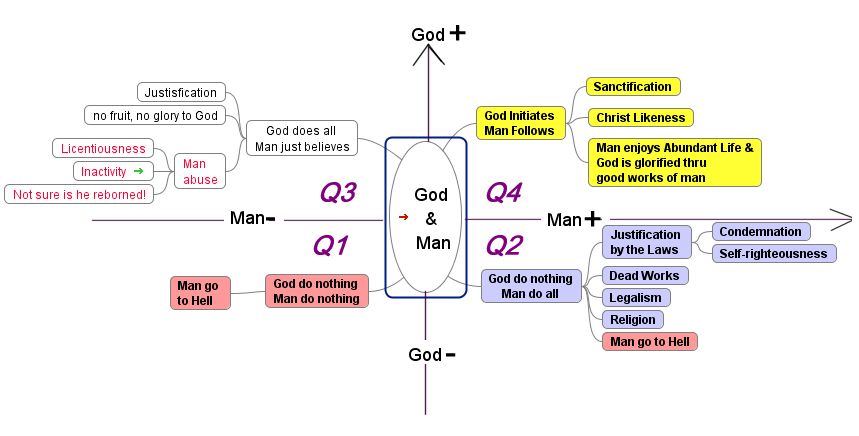
There is much confusion about man's effort in relation to God. On one side, we hear that man should rest on God's finished work and hence man should do no work, otherwise it is of the flesh and that is against God. On the other side, we hear that man should be the light and the salt of the world and hence need to do good work. People who lack understanding will be struggling between Book of Roman's Grace and Book of James' Work.

Hopefully, the chart below, a 2x2 matrix, can shed some light:
We starts with Quadrant 1 when God and Man make no effort. In this case, Man will naturally go to hell.

In Q2, God still rest and Man tries his best to save himself. Man comes out with all kinds of religions, every educational efforts to save himself. Man tries to follow God's laws to get justification. All he ends up with is either self-righteousness ( I attain the standards of God by my own interpretation) or self-condemnation when I fail. All these man efforts without revelation of God's will and initiated by man alone are dean works. After all the hard efforts, man still go to hell.

In Q3, God does all the work of saving man (by sending His Son Jesus Christ to die for us). Man just rest and really rest on God's finished work. He does not want to take any effort, everything is wait on God. There is the extreme case that since God has already saved me and then I can do all the things I like, including sinning.... we have this abuse of God's Grace.

In Q4, God initiates and man responds by following God's direction. In this way, the saved and new spiritual inner man is revealed in the outer man of good works that bring glory to God and satisfaction to man. God is glorified through the victorious living of man. Man is relying on God's grace to live up to God's standards. This is the desirable and ideal state. Man needs to do the work that God has called us and saved us for. Eph 2:10.