2008-02-14

Bible for Business Seminar#5 Vision & Values

#5 Painting the Vision & Choosing the Values
I. VISION
Vision is a picture of what we want to become. Vision gives life to mission. It describe what accomplishing the mission will look like at a future point of time. Vision is the dream, a destination. Values are what you stand for and give character to your corporation. Values determine the framework and boundaries for your strategies to realizing your vision. Mission, Vision and Values are related. A person or corporate is created with a mission with character of values trying to accomplish a vision. It is what you are (mission-identity), what you will become(vision) and how(values) to do go about achieving it.
Importance of Vision
You will not be greater than what your vision is. Prov 29:18, Pro 23:7.
Keys in Defining a Vision
Have faith in God. Prayed to discover what God want you to become. Do we fall into the following errors?
  • Looking at our present limitations or past failures to define your vision. If so, it would be very restrictive.
  • Be satisfied with your present and do not want to change. If so, you are growing old.
Recommended book : Joel Osteen's "Becoming a Better You"
Recommended Message: AR Bernard's"Audacity"
A Good Vision Statement.
1. Use the Terms and Things of your Audience.
We cited Mt 4:19, John 4:13, John 6:35, John 3:16, 7:38, 8:32, 11:25, Mat 11:28 as examples of Jesus describing the same vision in various ways to convey it correctly to the people.
2. Must offer "Things of Values" or "Benefits" to your customers, staff, and partners and owners.
3. Vision needs to be written down and communicated often. Hab 2:2
4. Vision must covers different aspects for the corporation - customers, processes, learning & growth (staff, skill, training, culture), social & environmental perspectives.
5. Chip Heath's 6 basic traits to make a message stick are:
1. Simple
2. Unexpected: audacious,challenging,
3. Concrete: measurable and have targets. You can tell whether you reach it.
4. Credible: challenging and yet believable. If it is incredulous, it will be ridiculed.
5. Emotion: motivating, giving pride,
6. Story: a good story or a good dream.
6. Must be communicated often and shared by all.
II VALUES
Values are what you believe as most importance, what you stand for, for which you will not compromise. They provides the decision making framework when there are no clear guidelines. They determine the Corporate character that is the sum total of the individuals working in the Corporate.
Bible tells us to see Corporation as
  1. Living Being (Rom 12, 1 Cor 12, Eph 4) - we are all members of the same body.
    1. Differences are respected, appreciated and treasured.
    2. Differences must be aligned and synchronized towards achieving the shared mission and vision.
  2. Family - relationship of love, care, protection, up-bringing.
Typical Values
Commitment – Passion, Perseverance, Overcoming, Creativity.
Empathy – Understanding Others, Culturally Savvy and extending help.
Respect & Trust
Integrity – Honesty & Competence
TRIP – Trust, Risk, Innovation, Progress
Learning, Innovation, Agility
Humility
Fun & Play
We cited two books "How" by Dov Seidman, and "The Future of Management" by Gary Hamel, that show how the business world are moving towards seeking significance on top on profits and share values, and adopting Biblical Principles in their business practices. Having employees satisfaction leads to profit too. 100 Best Companies to Work for in America between 1998 and 2005 returned 14% per year, compared to 6% a year for the overall market.
Seminar Response & Feedback
Yesterday was Chinese New Year 7th day -the People's Birthday. So we see many people having dinner at the restaurants around our church and causing quite a big jam. It took me extra half hour to reach church. There were 12 people who attended the seminar. The overall satisfaction rating was 86%. The highest score go to 'Knowledge of Speaker', 'Recommend to Friend'... with lowest score to time of talk, but still at 78%.
Like Best
  • The definition of vision/mission and factors to consider to derive a mission statement. The biblical references. It's a diff and unique perspective that is biblical & practical at the same time.
  • About setting of our vision beyond our limits. It's really encouraging to hear that.
  • Vision; It gives practical advice on how to set good vision statements. e.g characteristics of a good vision statement is very informative & helpful for those setting their vision statements
  • Applications
Like Least
  • Value topic. Not quite understand how to apply on my work.
Others
  • more of such sessions
  • overall presentation is grounded and very practical yet biblical.
  • Review the Previous Seminar
  • Coming to this seminar is like listening to 10 authors summarizing their books
Timing of Seminar - 2 times a month for the future.
Majority of those present supported the idea of having the seminar fortnightly instead of the present monthly.
The next seminar#6 "Appreciation of Situations" will be conducted on 27 Feb, Wed, 8pm at Church.

2008-02-13

Judging Rightly

In the last post Judge Not yet Correcting , we said Jesus did not tell us not to judge (Luke 6:37) but tell us not to judge blindly with prejudice, subjective, biased and hasty conclusions about others. We are told by Jesus in (John 7:24) to judge with right judgment.”

We said the proper way to judge is to really follow the process of the typical court. Paul in 2 Tim 3:16-17 tells us how to do it properly.

  • 2Ti 3:16-17 KJV All Scripture is given by inspiration of God, and is profitable for doctrine, for reproof, for correction, for instruction in righteousness: (17) That the man of God may be perfect, thoroughly furnished unto all good works.
I. The Truth & Standard

Firstly, we must have the truth - the correct doctrine as standards for measure. In other translation, teaching is used in place for doctrine. We must have the materials - the Bible and then we must teach and train our people.

Secondly, in the application of our learning, our behavior, words or beliefs can be compared and validated against the Biblical teachings, and judged to be right or wrong. GNB uses "rebuking error" for reproof - pointing out the wrong beliefs or lies we may hold.

Thirdly, knowing one's error is not good enough, we need to know what is correct belief. Correction is more than saying what is wrong and must say what is right. Rebuking & Correcting is better known as Counseling. This order is very important - Training comes before Counseling. Counseling is needed when we put our training into practice and encountered diffculties when we need Coaches to help us. Most people don't attend training and expect just Counseling to solve their problems. It is not effective and waste more time.

So, judging correctly must begin with an understanding of the Biblical Truth & Standard and then observing and finding the behavior and comparing against the Standard, rebuking and correcting towards re-establishing the right thinking and right behavior. If judging is not a good word to use, substitute "Counseling" or "Coaching" in its place. We are not to blindly judge but to counsel one another wisely in gentleness and the Biblical Truth.

The forth part is "training in righteousness" or in GNB "instructions for right living". The Biblical Teaching or Truth in part 1 should result in practical applications and instructions for right living. Paul in his letter always start with doctrines and then cover the practical applications - how one should behave as a Christian, as parents, children, bosses, employees, elders, etc. Making an error helps us to understand the "instructions in right living" better.

II The Observations
A potential error in making judgment is the not observing correctly, insufficient or wrong facts, unvalidated hear-says, and so forth. At times, even the witness may make observation errors or there are false witnesses. The Biblical teaching is very clear, Mat 18:16, 2Co 13:1, 1Ti 5:19 evidences(not hearsay) of two or three witnesses. The accused should have the right to face up with the witnesses and questions them for clarification. 1Ti 6:12, 2Ti 2:2, many witnesses should be preferred. Because of the possibility of false witnesses, the character of the witness should be considered as well.

III The Internal Motivation
Finally, the true judgment should be made of the intention of the heart and not the outward behavior. But we can only infer the intention. Only God knows. Our judgment could be wrong. Hence the need for more judges.

With such difficulty, it is no wonder why Jesus admonish us not to judge blindly. Nevertheless, we have the responsibility of helping and counseling our brothers when the needs arise. We prayed that we can do them wisely and gently with insights from the Holy Spirit. As a reminder, Training must comes before Counseling.

2008-02-11

Judge Not yet Correcting

On the one hand, we have Luke 6:37 teaching us not to judge another so that we may not be judged. On the other hand, we have the responsibility of admonishing, rebuking, correcting our wayward brothers in Christ(2Tim 2:25 ESV, 2Tim 3:16 ). How can we correct another without first making a judgment? Is the Bible inconsistent?

The Bible is the written Word of God (2Tim3:16) and hence cannot be inconsistent. Whenever we come across such seemingly contradictory teachings in the Bible, we must first conclude that it is our outstanding and not the Bible that is at fault. We must also congratulate ourselves that we have hit upon a treasure of wisdom. If unravel the contradiction, we would have gained a great understanding.
  • 2Ti 3:16-17 KJV All Scripture is given by inspiration of God and is profitable for doctrine, for reproof, for correction, for instruction in righteousness: (17) That the man of God may be perfect, thoroughly furnished unto all good works.
Way Out 1 - Differentiate the Act and the Person
In Luk 6, we can see that the text refers to the people more. We can judge the actions as evil but not condemn the person at the same time. We are told to love the person and not his evil or sinful acts. We have the Bible as the standards of right and wrong and we can for many cases make a sound judgment provided we have all the relevant facts. However, the intentions of the heart are not easily observed. We could only make inferences. Even if the accused said what his intention was, his words need to be evaluated as to whether he was speaking the truth or not. This leads us to the next interpretation of 'Judge'.

Way Out 2 - What is the Meaning of 'to Judge'
To make a judgment of right or wrong, we need to have the following steps as shown in the mind map below:


I think the 'judge' used by Jesus in Luk 6:37 does not mean the whole fair process of collecting the facts from all angles and then making the best conclusion, but a hasty, narrow, biased and prejudiced conclusion. This interpretation is supported by the following verses. In v39, it was recorded for our benefits that "He also told them a parable: “Can a blind person guide a blind person?"... showing he meant making a blind judgment. In v41 "Why do you see the speck in your neighbor’s eye, but do not notice the log in your own eye?", it shows we are making a biased and prejudiced view of our brother actions. Jesus also provided the answer on how to judge rightly in v42 "Thou hypocrite, cast out first the beam out of thine own eye, and then shalt thou see clearly to pull out the mote that is in thy brother's eye. ". We need to first remove our biases and prejudices first. i.e. follow the proper judicial process to arrive at a proper judgment. Since only God knows the intent of the heart, God is still the best judge of all. We must humbly acknowledge that we have a biased tendency and need to take steps to minimize that.

So, I think a better translation of Luke 6:37 is: "Do not jump to hasty & biased conclusions about others so that you are not similarly judged....."

2Tim 3:16-17 shows the better way of making judgment and correcting our brothers .... next post judging rightly and see also Making a Judgement and Being Judgemental

2008-02-09

God Initiates & Man Follows

There is much confusion about man's effort in relation to God. On one side, we hear that man should rest on God's finished work and hence man should do no work, otherwise it is of the flesh and that is against God. On the other side, we hear that man should be the light and the salt of the world and hence need to do good work. People who lack understanding will be struggling between Book of Roman's Grace and Book of James' Work.

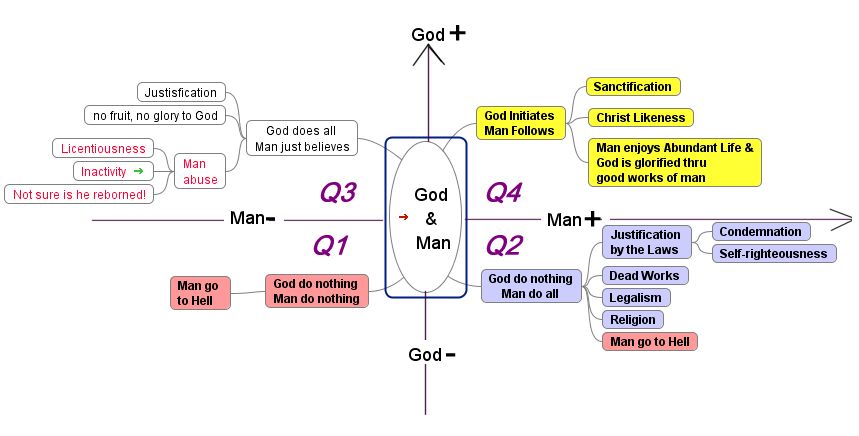
Hopefully, the chart below, a 2x2 matrix, can shed some light:
We starts with Quadrant 1 when God and Man make no effort. In this case, Man will naturally go to hell.

In Q2, God still rest and Man tries his best to save himself. Man comes out with all kinds of religions, every educational efforts to save himself. Man tries to follow God's laws to get justification. All he ends up with is either self-righteousness ( I attain the standards of God by my own interpretation) or self-condemnation when I fail. All these man efforts without revelation of God's will and initiated by man alone are dean works. After all the hard efforts, man still go to hell.

In Q3, God does all the work of saving man (by sending His Son Jesus Christ to die for us). Man just rest and really rest on God's finished work. He does not want to take any effort, everything is wait on God. There is the extreme case that since God has already saved me and then I can do all the things I like, including sinning.... we have this abuse of God's Grace.

In Q4, God initiates and man responds by following God's direction. In this way, the saved and new spiritual inner man is revealed in the outer man of good works that bring glory to God and satisfaction to man. God is glorified through the victorious living of man. Man is relying on God's grace to live up to God's standards. This is the desirable and ideal state. Man needs to do the work that God has called us and saved us for. Eph 2:10.

2008-02-01

Dedication Prayer - What's Wrong

The Dedication Prayer
This is a typical and considered very good dedication or repentance prayer easily found on internet:
Lord Jesus,
we have not always put you first.
Our lives have not always be in submission to you.
Our hearts have not always been focused on you.
Forgive us, Change us, turn us around, transform us!
In Jesus' Name, Amen
Can you find any thing wrong with it?
Do you think God can answer prayer like that?
The first part is confession of facts - not put Jesus 1st.
The 2nd part, the change, is usually where the misunderstanding occurs that resulted in most Christian living a defeated life.
The main error is that we are asking God to do the thing that He has already done!
It is like having the money in our hand and in our bank account and then still asking our parent for more money.
God cannot give you again what He has already given you. His answer to our such prayer will be "I've done it. It is with you. Use what I've given you. It is not with Me. It has already been given to you through Jesus Christ.
We have, in a subtle way, asked God to do the thing that we should be doing - believing and acting on the accomplished work of Christ.
We have passed our task back to God. We are told to speak to the Mountain about God and not speak to God about the Mountain.

Mar 11:23 KJV For verily I say unto you, That whosoever shall say unto this mountain, Be thou removed, and be thou cast into the sea; and shall not doubt in his heart, but shall believe that those things which he saith shall come to pass; he shall have whatsoever he saith.

#1 Forgive Us
This is the acknowledgement of our wrong doing. We must be able to face up with our wrong doing so that we can change. Repentance is about changing our mindset and behavior to follow Jesus. We must be clear about the timing - when did God know about our sinning? God know about our wronging doing before we discover about it. We need to rest on the fact that all sins, past, present and future have been paid for and forgiven by Jesus' death on the Cross two thousands year ago; at that time, all our sins are in the future and have been nailed to the cross. Our sins or wrong doings are not forgiven at the time of our confession but forgiven 2K years ago. 1 John 1:9 is given to assured us of His forgiveness and for us to use against the Devil's accusation, causing us to feel guilt and shame and to run away from God. (BTW, Devil's tricks are lies, temptation, accusation and driven from Fear. He tell a lie to tempt us to sin and then accuse us.) When we sin, we must come quickly to the throne of grace Heb 4:16 Let us therefore come boldly unto the throne of grace, that we may obtain mercy, and find grace to help in time of need. Do not be tricked by the devil that God is holding our sin against us. Get up from the floor and move ahead with the change because God has already forgiven us though Christ and get the Grace Power of Christ in us to move ahead.
#2 Change Us
When we received Jesus as our Lord and Savior, we are changed already - our spiritual man is rebirth by the Holy Spirit. 2Co 5:17 KJV Therefore if any man be in Christ, he is a new creature: old things are passed away; behold, all things are become new. So, this request have been answered. God change us from the inside and we are to work it out Php 2:12. Rom 12:1-2 tells us to offer our body as a living sacrifice, and be transformed by the renewing of our mind (with knowledge of God - starting with the Bible). We has control over our mind and body. We do the change that God has already started within us.
#3 Turn Us Around
God makes not robot. We have ownership of our will. We must will to follow God's will. It is our responsibility to exercise our will.
#4 Transform Us
As pointed above, God has already transformed us from Adam's nature to Christ's nature. All we need to do it to work it out - that our soul and body becomes the medium of God's character that is inside. We become the instruments of God in this present work - touching lives and glorify God with our work.
Conclusions - I can do all things through Christ
Don't ask God to do thing that He has already empowered us, through the Grace in Jesus Christ, to do. Don't blame God for not answering our prayers when we should be one doing the things He has asked us to do. Get up, know the Bible, know His will and just be obedient to His calling and His will and move forward courageously and victoriously. Don't get stuck in the mud of self-pity and blaming God. The 2nd part of the dedication prayer should be : I have realized my mistake and want to turn around. Thank you God for forgiving me. Thank you God that you have transformed me and had given me a New Life and Identity. I'm your children. I've Christ in me. I can walk this new way because Php 4:13 KJV I can do all things through Christ which strengthened me.

A Positive Dedication Prayer
The following song used in a Children Church presentation is an example of a good dedication prayer.

  • Dear God,
    • Thank you for loving me. And giving me Your all.
      When I grow up, I will still be serving You.
      want to know you more. I want to love you more.
      I will never forget You Lord.
    • In Jesus' Name

2008-01-27

Taking Back the Initiative - Going the Extra Mile

With reference Mat 5:38-48, especially v39, "...But if anyone slaps you on the right cheek, turn to him the other also", many people are confused about what it means. Some people even misunderstand it to mean Christians are to give in to bullies.

In the passage, we have the contrasting teachings of the world and the kingdom of God.
The worldly teaching is
  1. An eye for an eye and a tooth for a tooth. vs38
  2. You shall love your neighbor and hate your enemy. vs43
In contrast, the Kingdom of God's teaching is:
  1. Do not resist the one who is evil - give more than than he needs. v39-42
  2. Love your enemies & pray for those who persecute you.
In v39, we must first differentiate the 'one', the person, from his 'evil' deed. The evil deed is defined in the context of slapping (one has not such right to hit another), suing to take tunic ( he is using legal means to get something that is probably not his), going the extra mile ( the special privilege of the Roman soldier) and so forth. The evil is making unreasonable demand on someone.

Surprise him - Do more than is Needed!
The worldly wisdom is for us to fight for our own right and to strike back or counter sue. Here, Kingdom's teaching wants us to look the need of the person who resorted to such evil act. He must be in dire needs to do such thing. Our reaction is not to fight back, but to find out the person's motivation and needs behind those evil actions. Jesus want us to ignore the bad acts and to empathize with the person and to help him instead. We need to go deeper to fix the problem at the root. Instead of fighting back, we ask "why are you doing it?", "what is your real need". Once we find out, we go out of our way to truly help him out.

Making unexpected reaction will surprise the aggressor (he expected us to fight back) and we take back the initiative so that we can be in position to influence and change the outcome for good.

Let's go One Step Further!
Not resisting evil and going the extra-mile while is good, is still not good enough. It is relatively passive in helping others; we are waiting for them to take action first before we response. So, Jesus go further in v44 that we should take the proactive step of loving enemy; praying for them first.

Before we argue with God that it is impossible for us to that, we need to know that God already know that we could not. That is why God has given us Jesus Christ in us to enable us. Because we are children of God with God's identity, then we could what God want us to do (v45, 48). We are to love with the love of Jesus that is in us. I call this the Rhodium Rule (Rodium is about 4-6 times the price of Platinum). As a side track, the three rules of love are:
  1. The Golden Rule - Do unto others as you would others do unto you (empathy is implied)
  2. The Platinum Rule - Do Unto Others as They Would Have You Do Unto Them (Do they know what is best for themselves?)
  3. The Rhodium Rule - Do unto others as Jesus would have us do unto them (For their Good from God's viewpoint).
Applying Them in Our Lives
We can apply the "Going the Extra Mile Rule" in our lives - in our business, family, and friends tec. In business, it means delighting the customers and differentiating our services from our competitors. Innovation Rules (BVITS's Intensified/Extremity) operator) tells us to look the needs and feedback not just from our normal customers, but the extreme ends of our customers. Those that are extremely happy with us and those that hate us. Digging deeper into their feedbacks can tell us a lot about our product and services and give us leads on to how to improve our products and services.

In business, going the extra mile for staff means
  1. as staff: giving our best in our works from our hearts as if we are working for Jesus Christ (Eph 6:5-8).
  2. as bosses: treating our staff with fairness, recognition, appreciation, trust and delegation of decision making authority, accountability and forgiveness for failures (Eph 6:9).
As a spouse, as parent, as children, etc are all covered well in Eph and Col.

2008-01-16

Where is Our Confidence?

As we start the journey of a New Christian Life, our main concern is how we can live a life that is pleasing to God. Some older Christians are even worrying about whether they can keep their faith in the increasing uncertainties and evil in the world.

It is best to get guidance from the Bible, especially from Paul. The book of Galatians (AD 49) was the earlier writing of Paul and 2 Timothy (AD 66) was his last. When Paul started his ministry, his motto for life was in Gal 2:20 as shown below:

The key to Christian Living is living by the faith of Christ in us. The mind map below shows an exposition of the verse.


By the end of his life, Paul gave the reason for his confidence and the driving force behind his life of victories - overcoming all the sufferings in various forms he described in 2Cor 11:23-28. It is in 2Tim 1:12 shown below:


After 17 years of living in Christ, Paul used the word "oido" for know - to know completely. According to Vines 'The differences between ginosko and oida demand consideration:

  • ginosko, frequently suggests inception or progress in “knowledge,”
    while oida suggests fullness of “knowledge,” '.
We need to know Jesus Christ, believe in Him, and be fully persuaded and convinced that He is able to keep the work He has entrusted to us.

Our confidence is in our faithful Saviour - Jesus Christ to complete the work He has given to us. It is so simple - He gives and He ensures our victory in life. Let us rest on the fact that He is our assurance that we will live up to His calling for us. We work from this sure foundation of victory and success.

======
A Summary:

Learning from Galatians 2:20:

Galatians 2:20 encapsulates the profound transformation that occurs in the life of a believer, emphasizing the Lordship of Christ and the essence of true discipleship. This verse provides a rich theological foundation for understanding the believer's union with Christ and the daily implications of living a crucified life.

  1. Crucifixion with Christ:

    • “I am crucified with Christ:” This signifies the believer's identification with Christ’s death. The "old me," which includes the old nature, the ego, and the self-centered way of living, is considered dead. This death means:

      • No longer being one's own god.
      • No longer needing to justify oneself.
      • Surrendering the right to rule one's own life, handing it over to Jesus.
    • Romans 6:6 and Galatians 6:14 further illustrate this concept, highlighting the abolition of the body of sin and the believer's separation from the world's influence.

  2. New Life in Christ:

    • “Nevertheless I live; yet not I, but Christ liveth in me:” The believer now lives a new life empowered by Christ. This new life is characterized by:

      • Becoming a new creation in Christ (Galatians 6:15).
      • Receiving a new heart and a renewed spirit, which includes:
        • Intuition and communication with God.
        • An awakened conscience.
        • A new relationship where God and Christ are first and all.
    • The soul, which includes the mind, emotions, and will, undergoes transformation:

      • The mind needs renewal through the Word of God (Romans 12:2).
      • Emotions are stirred by the love of God, producing fruits like joy and self-control (Galatians 5:22-24).
      • The will learns to yield to the Holy Spirit.
    • The body becomes an instrument for good works in Christ, living as a living sacrifice (Romans 12:1, Ephesians 2:10).

  3. Living by Faith:

    • “The life which I now live in the flesh I live by the faith of the Son of God, who loved me, and gave himself for me.” This indicates that the believer's daily life is lived by the faith of Christ within them, not merely faith in Christ.
      • Philippians 2:13 supports this, stating that God works within the believer.
      • This faith brings confidence and assurance, as expressed in 2 Timothy 1:12 and Jude 1:24.
  4. The Lordship of Christ:

    • The believer belongs to the Lord, whether in life or death (Romans 14:8-9).
    • Living is for Christ, and dying is gain (Philippians 1:21).
    • Christ died and rose again to be Lord of both the dead and the living.
  5. Practical Application:

    • Colossians 3 outlines how this new life in Christ should be lived out:
      • Seeking things above and setting minds on things above (Colossians 3:1-4).
      • Getting rid of the old self and its sinful practices (Colossians 3:5-9).
      • Living out the new self by loving and building up one another (Colossians 3:10-17).
      • Embracing godly roles in various relationships (Colossians 3:18-25, 4:1).

By daily choosing Christ's way over our own, believers continually live out their new identity in Christ, growing in faith and reflecting His lordship in every aspect of life.

2008-01-10

Bible for Business Seminar#4 Personal Mission & Journey

#4 Your Personal Mission Statement & Life Journey
The following main points were discussed at yesterday meeting.
  • Identity of Man – Purpose of Creation of Man
  • Your Unique Calling – Discovery of
  • Your Life Journey – Importance of
  • Your Helps & Hindrances – The How of Victory
  • Your Rewards
Identity of Man
Eph 1:4-5 tells us Man is created to be Sons/Daughters of God through Jesus Christ to be Holy and Blameless(Righteous). God did not create many men to be his children. God begets us and want to father us as his children. The whole universe is created for His children(Us!) for our living.

Your Unique Calling – Discovery of
  • By Name & Direct Calling
    Abram Gen 12:1-3, Moses Exo 3:10, Paul Act 9:3-6
  • By placing an unquenchable desire in a heart
    Nehemiah ; Isaiah 6:8, ..Writer, Dancer, Musician, Businessman.
  • By arranging a clear path (Pray for Opportunities – Opened Doors)
    Daniel, Josiah 2 King 22
  • By preparing an attractive option
    Elisha by Elijah. Stephen as Deacon.
  • By your talents & gifts.
Our ability to hear requires a desire and devotion to God… spend time in His presence to recognize His voice from the noise. Calling is Progressive…need to get your feet wet first.
Your assignment may change but the calling is fixed. (Story of Joseph). Calling is the Key to Contentment in your vocation/business. Lots of Noises --- from family, friends, colleagues, commerce and community and you need to stay your path.

Your Life Journey – Importance of
The journey is important. Else, we all will go straight to heaven upon conversion.
In this journey, we can truly learn to experience the love and relationship with God.
No matter what, God is there for us, in joy and sorrows (2Co 1:4). Jesus is Lord.
Knowing more stimulates the desire to know more …. That is growing in love with Christ. Php 1:9, 3:10.

The How of Victory - The Unified Model of Transformation
This is an updated chart 1st appeared in Christian Transformation & Growth -The Unified Model.

Kent gave some very good illustrations. We can compare the above chart as driving a car - moving forward. But after a while, we find that we are not moving as forward as fast as we should. We then discovered that we did not release the handbrake - the load. Another picture is sailing a boat. We started off fine and then we just some how got stuck - unable to move forward any more. We then discover that we have not pull up the anchor. The anchor - the load, need to be lifted for the boat to go forward. The recommendation is that we use the resources given to move forward and when we find we are immobilized, we should examine the loads and resistances that are holding us back. We may need to seek counseling and healing before we can go forward again.

Work of Flesh vs Work of Faith
We also pointed out that some Grace-Based teachings ignore the journey to a destination and just want the final good outcomes. Some have mistakenly assume all effort is work of the flesh. Whether work is of the flesh or of faith depends on the underlying motivation. Below is table to show the differences.

Flesh

Faith

Justify Self

Glorify God

Self-Initiated

Response of Faith, Obedience to God’s Calling

Self-Capability

Grace-Empowered & Capability
(Greater Results)

Have-Do-Be

Be-Do-Have


About 23 people attended the seminar with overall rating of 84%. Below are some of the comments:
  • My identity is not defined by a vocation. My journey may take me through different vocations to arrive at destination. Personality and Environment is the key to contentment in our vocation. Why? Because I struggled for years with all that and tonight I am getting some clear directions.
  • Disover my calling through God's word
  • Examples of Joseph's Identity to know God's callings. Be-Do-Have (process) vs Have-Do-Be
  • Disover my calling.
  • Discernment between works of the flesh and faith driven works. Clear Dictinction.
    Content is clear.
  • Chart, map very good.
  • Use skills + knowledge to guide people of God in the market place; not so much spiritual talk but can somewhat relate Bible scriptures to work related or investments.
  • Christians Growth Chart. Summary of the Drive/Force.
  • Discover your own strength.
  • talk too fast, can slow down a little.
  • Many Gems in 1 hour. Some speaker has 1 gem in hour. The key is balance - some points need to elaborate.
  • I thought this was one of the best sessions yet. Everything that was shared was fresh insight and hence refreshing to learn.
  • The part about the importance of the journey also resonates with something that God taught me some years back about the fact that (borrowing from one of Singapore Airline’s marketing slogans) the “Journey is the Destination” and that our God is one who focuses so much more on who we BEcome (human BEINGS) rather than necessarily what we achieve ( not human DOings).
  • The clarification of the underlying motivation of work (flesh vs. faith) was important in qualifying the grace message very succinctly for me personally. Thanks!
  • The “How” of Victory was also fresh and instructional.
  • Have-Do-Be v.s Be-Do-Have was also insightful and follows on from the fact that while the devil works from the outside-in, God works opposite to that – from the inside-out.

2008-01-05

The Lord's Word & Doctor's words

Do we give the Bible the same weight as our medical doctor's words?

We say we believe the Bible is the Word of God. It is the standard of our behavior. It's promises are true. Its commands are to be obeyed. Yet for many of us, when we feel God wants us to do something, we want to decide first - whether we should do it or not.

However, when our medical doctor gives us a prescription and advice, we are quick to follow, knowing for sure that they are for our good.

Why is that so? Do we trust our God less than our medical doctor?

One reason I can give is that at times we are not sure whether is word is from God or not. We want to be sure it is from God. 

At times, even when we know it is from God, we are unable to see how to execute it. God will make it clear to us when we have the intention to follow Him. Taking time to make sure, and seeking wisdom for execution are good for us to learn to hear God better. 

But we must make sure we don't treat God's Word less than our medical Doctor's.

----
ChatGPT gives the following summary:
In summary, while it is natural to wrestle with these issues, the journey of faith involves growing in our ability to hear, trust, and obey God's Word, just as we trust and act on the advice of a medical professional. Balancing discernment with trust is key to deepening our walk with God.
Gemini said:
Ultimately, the goal is not to pit faith against science but to integrate both in a way that honors God and benefits our lives. By approaching both with respect and discernment, we can cultivate a deeper trust in God's plan and purpose.
Perplexity:
The key might be to develop a more integrated approach to decision-making that values both spiritual wisdom and practical expertise, recognizing that both can contribute to overall well-being. Ultimately, for believers, cultivating a deeper understanding of and trust in God's word could lead to it being given equal or greater weight in decision-making processes.

2007-12-28

Imitation of Christ & Living Out Christ

(go to Chinese 华文 text)

We are all called to be Christ's clone in the world Rom 8:29 For those whom he foreknew he also predestined to be conformed to the image of his Son, in order that he might be the firstborn among many brothers. 

We are to imitate Christ. But we all know that Christ's model is of the highest standard and we have trouble imitating it. Many shy away from admitting they are Christians in front of others because they know that even non-believers have some high expectations of Christians. There are some who decline leadership because they don't think they can live up to the standards required of leadership.

In my own experience, when being reminded of the need to correct some bad behavior, or to start some new project, I told God that it was tough on me. I argued that it was the way I was built. I am strong in there and weak in here. Can you, God, let it go? 

But God reminded me that it was not a good excuse. He understands our weaknesses and hence has given us :
  • Jesus Christ in Us (CIU) Col 1:27(To them God has chosen to make known among the Gentiles the glorious riches of this mystery, which is Christ in you, the hope of glory.). 
  •  We have 2Co 12:9 But he said to me, "My grace is sufficient for you, for my power is made perfect in weakness." And 
  • 2Co 9:8 And God is able to make all grace abound to you, so that having all sufficiency in all things at all times, you may abound in every good work.
Our imitation of Christ is only possible when we draw from the Grace that is in Christ in us. We need to live out the Christ in us. It is impossible to live to Christ's standard through our own efforts.
  • Ephesians 6:10 - "Finally, be strong in the Lord and in his mighty power."
Hence, let us in faith, trusting in the grace of our Lord Jesus Christ, boldly step out in this journey.

Comments by ChatGPT: Is the message good?

Yes, the message is thoughtful and encouraging. It acknowledges the realistic struggles Christians face in living up to Christ's example and offers a balanced perspective by emphasizing reliance on God's grace and strength. Here are a few points that make it effective:

  1. Realistic Acknowledgment: It starts by recognizing the difficulty of imitating Christ, which can resonate with many who feel the same way.

  2. Scriptural Foundation: It uses specific Bible verses to support each point, grounding the message in biblical teaching.

  3. Encouragement and Hope: It shifts from acknowledging human weakness to offering hope and encouragement through God's provision and grace.

  4. Practical Application: It encourages believers to act in faith, relying on Christ's power, which is a practical and actionable takeaway.

Overall, it effectively combines empathy, scriptural support, and practical advice, making it a strong and motivational message.


======

读经分享 1047
基督的模仿与活出基督

我们都被呼召在这世界上成为基督的形像,罗马书 8:29 (因为他预先所知道的人,就预先定下效法他儿子的模样,使他儿子在许多弟兄中作长子。)我们要模仿基督。但我们都知道,基督的模范是最高标准的,我们很难模仿。
  • 许多人在其他人面前不愿承认自己是基督徒,因为他们知道即使是非信徒也对基督徒抱有一些很高的期望。
  • 有些人拒绝领导,因为他们认为自己无法达到领导所需的标准。
根据我自己的经验,在被提醒需要纠正一些不良行为或开始一些新项目时,我告诉上帝这对我来说很难。我辩称这是我天生的方式。我在某些方面很坚强,在某些方面很脆弱。上帝,你能放过我吗?

但上帝提醒我,这不是一个好借口。他了解我们的软弱,因此赐给了我们:
  • 基督在我们里面(CIU)哥罗西书 1:27(神愿意叫外邦人知道这奥秘的丰富荣耀是什么,就是基督在你们心里成了有荣耀的盼望)。
  • 哥林多后书 12:9 但他对我说:“我的恩典够你用的,因为我的能力在软弱中显得完全。”
  • 还有哥林多后书 9:8 神能将各样的恩惠多多地加给你,使你在各样事上常常富足,可以多多行各样的善事。
只有当我们从基督里的恩典中汲取时,我们才能模仿基督。我们需要活出内在的基督。通过我们自己的努力,不可能达到基督的标准。
  • 以弗所书 6:10 - “我还有末了的话:你们要靠着主的大能,和他权能的能力刚强起来。”
所以,让我们带着信心,靠着耶稣恩典的大能,勇敢的开始吧。

Lim Liat (c) 28-12-2007 updated 21-8-2023

2007-12-13

Bible for Business" Seminar#3

We had a wonderful discussion in "Bible for Business Seminar#3" yesterday night. We use "Breadtalk" as illustration of a mission statement showing how mission statement influence the way do our business. Most of the materials covered were given in BJ#2 Have A Mission Statement. We encouraged all to review their mission statement using the following guidelines:
  1. Inspiring ?
  2. Long Term Value and Worth - treasures of the heart.
  3. Singleness in Purpose
  4. Action Verbs: GO, Become, Be .....
  5. The Scope, the How and the What of resources.
  6. Targeted & Concise & Easily Understood & communicated.
Sometimes, we may need look at what is not to help us clarify our mission statement.

As our resources are limited. We stress on removing waste. Waste are those those activities that do not contribute to the accomplishment of your mission. We should channel those resources into activities that do support the mission. There is the need to prioritize our activities and use of resources. A participant shared that we should follow the Holy Spirit one step at a time.

The next seminar is on 8 Jan 2008 8pm at Church. It will be "Discovering your Calling and setting your personal Mission statement". See you there.

The participants, about 17, gave the seminar an overall rating of 90%. Some feedbacks were:

What they Liked Best:
  1. Discovering your caling for God in having/forming a mission and praying for a vision-looking forward to understand that for our busines. All explaned is valuable and helpful
  2. The fact that all bases are covered starting with the foundations of understanding who God made you to be and how to articulate it through having a personal and business mission statement. Looking forward to covering "vision" segement. Thanks again.
  3. BZ mission + vision must tough life, relationship + network(value)
  4. "Mission statement - why it is so important & crucial
  5. Asking the right questions."
  6. Perspective of mission
  7. How to define your mission and vision. Showing example how corporation work
  8. The Q&A session. Inspired me to think deeper into the topic of discussion.
Others
  1. more image or illustrations linked to the topics
  2. advertise this seminar to greater group of audience
  3. try not to rush the topic too fast
On Speaker
  1. very knowledgeable, full of passion
  2. bring Holy Spirit in to the subject. E.g. How Holy Spirit can help in the achievement of your mission

2007-12-11

Giving & Receiving in Christmas

Christmas is about the greatest gift of God, His Son, Jesus Christ, to man.
It is the greatest from God's viewpoint - His only Son given to die and to pay for man's sin.
It is the greatest from man's viewpoint - Man can now live forever with God.

We catch the spirit of the loving God - giving of Himself.
We say the spirit of Christmas is about giving.

However, now that God, in His love, has given us the best and greatest gift, it is more important for us to receive His gift of love.

A gift of love not received is a great pain to the giver. The greater the love and the gift, the greater the pain that rejection causes. Don't reject this love from God. Receive His gift of Jesus Christ.

I prayed that in this Christmas, many will truly receive the Gift of Jesus Christ from God and be born anew into a new joyful relationship with God the Father. The very wish of God the Father is for us to receive His Son, the Gift.

Let us learn to receive the gifts of love from those who dearly love us this Christmas.
Christmas is more than just giving but also properly receiving the gifts of love, especially, the receiving the greatest Gift of all from God our heavenly Father.

2007-11-28

Culturally Savvy & Connectedness

It is always nice to know that your thought and ideas are shared by some people with greater influence, such as authors or famous preachers.

The idea is that for the Gospel to be preached more effectively, we need to understand and appreciate the culture into which it is shared. See the mission and vision statement of my church, Petra Church. In the past, when the gospel was brought from the West into the East, they tend to impose their western cultures and practices into the Eastern population that they were reaching. They condemned the spiritually neutral traditions and practices as demonic and insisted on removing them. (Of course, there were also many eastern practices that were and are demonic. Such traditions and practices need to be stopped.) It ended with creating a Christians subculture and Christianity being branded as Western Religion with the implication that it is not acceptable and should be rejected by the people. Whereas in actual historical fact, the origin of the Christian faith comes from the east and the teachings and practices of Christianity and the Jews are very much like the Chinese. The other religions had done a much better job for integrating the local cultures into their religion. We need to be wise to differentiate the spiritual and spiritually neutral content of the cultures and traditions first before we blatantly proclaim they are demonic. We need to appreciate and connect to the cultures so that the impact of the Gospel can be more effective.

The author is Dick Staub and his book is The Culturally Savvy Christian: A Manifesto for Deepening Faith and Enriching Popular Culture in an Age of Christianity-Lite
While the book is more relevant to the US society, the key points are applicable to those of us in the East. We must always make sure the church stay connected and relevant to the people of different cultures, by race, by age-group, by life-styles, by professions, etc, that we are reaching. One message that touched me most is "Be an artist who is deeply Christian, not a Christian artist. C S Lewis quipped that we don't need Christian writers, we need great writers who are Christian. Instead of creating a separation, we need to connect to influence them and to be adopted.

To influence others come with understanding and appreciating them first. Habit#3, of the 7 Habits of Highly Effective People, is seek first to understand and then be understood. If I don't think you understood me, my feelings, thoughts and need, I don't think I can accept or trust your advice. This is precisely what Paul is sharing in
  • 1Co 9:20-23 And unto the Jews I became as a Jew, that I might gain the Jews; to them that are under the law, as under the law, that I might gain them that are under the law; (21) To them that are without law, as without law, (being not without law to God, but under the law to Christ,) that I might gain them that are without law. (22) To the weak became I as weak, that I might gain the weak: I am made all things to all men, that I might by all means save some. (23) And this I do for the gospel's sake, that I might be partaker thereof with you.
To connect, we may run the risks of becoming like them. v21 stressed that we are to maintain our special identity (under the law to Christ), that we may give the light and salt of the gospel.

Let begins by understanding another culture first and then bring our gospel to them.

2007-11-23

Freedom - it is without limits?

Is freedom really without limits?

The levels of Freedom are:
  1. Freedom from Bondage
  2. Freedom of choice of action
  3. Freedom to choice of not to act
Level 1 Freedom from Bondage
This level 1 freedom is easier to understand. We are freed from bondage of sin, sickness, bad habits, bad temper, demonic harassment and other. Another word for it is "Deliverance". This is a key essence of the gospel.
  • (Luk 4:18) "The Spirit of the Lord is upon me, because he has anointed me to proclaim good news to the poor. He has sent me to proclaim liberty to the captives and recovering of sight to the blind, to set at liberty those who are oppressed
Even nature needs to be freed from the law of entropy ....
  • (Rom 8:21) Because the creature itself also shall be delivered from the bondage of corruption into the glorious liberty of the children of God.
Level 2 Freedom of choice of action
Since we are set freed, we have the ability to choose our actions. However, are there no limits to our freedom. The following verses tell us that our freedom is in Christ Jesus.
  • (Gal 2:4) And that because of false brethren unawares brought in, who came in privily to spy out our liberty which we have in Christ Jesus, that they might bring us into bondage
  • (Gal 5:1) Stand fast therefore in the liberty wherewith Christ hath made us free, and be not entangled again with the yoke of bondage.
If freedom is in Jesus Christ, then outside of Christ, there is no freedom. There is therefore a limit to our freedom. If we try to use our freedom outside of Christ, we will get back into bondage and be enslaved by sin or the devil.

With freedom then comes the responsibility and accountability for our actions. While we are free to act, we have to be responsible and be accountable to the consequences that our action bring.

Even just considering ourselves, our bodies have limitations. There are only so much activity, we could do without harming our bodies. There are natural laws controlling this universe. Try defying the law of gravity without aids and the consequence is death - complete lost of freedom in that law defying act.

Level 3 Freedom of Choice of No Action

Most people stressed on freedom to act. But one of the choice of action is not to take action at all. This is clearly highlighted in 1 Cor 8 about eating food offered to idols. While we are free to eat, we choose not to, for the love of our brother.
  • (1Co 8:13) Wherefore, if meat make my brother to offend, I will eat no flesh while the world standeth, lest I make my brother to offend.
For people who stress on freedom to do anything, how about stressing on freedom to love.
  • (Gal 5:13) For, brethren, ye have been called unto liberty; only use not liberty for an occasion to the flesh, but by love serve one another.
Freedom to love bonds us! There are many actions we would not do because of love. Of course, there are much much more actions that we could do to express our love to others.

As we are not alone but vitally linked to one another, we freedom has limits that we choose to adhere to, because of love and relationship for one another. In this light, freedom without limits and consideration for self and others could be called "destruction".

2007-11-20

Know Do Gap

Joh 8:32 And ye shall know the truth, and the truth shall make you free.

The word "know" in the greek is ginosko G1097.

According to the appendix of the Companion Bible

  • ginosko = to know (by experience, or effort);.....
Freedom comes from not just knowing the Truth but by doing the Truth and then experience it.
Knowledge without doing is insufficient.

If we just gain knowledge by reading, hearing or watching videos or TVs, without any intention of doing it, then we are just entertaining ourselves. The purpose of learning is to have a change in our mindset, attitude and our behaviour. True learning occurs when there is behavioural changes.

I would like to recommend these two books that address the "Know Do Gap" very well.
They are:
The first book the authors give eight guidelines for action (rephased by me. Read original book for original wording):
  1. Know Why before How to have the motivation and learning effectiveness to put into practice. Chinese says 活用 - ability to apply it with wisdom and flexibility.
  2. True Knowing Comes from Doing and Teaching Others How.
  3. Planning without Actions is useless. Decision to act is not good enough. Must have follow-up to ensure execution.
  4. Must allow for failure and learning from them because doing is not without Mistakes.
  5. Fear prevent us to learn new things and try new things. So we must remove them.
  6. Internal Competition is not a good way to encourage progress in general (see the book for specific instances that it is ok).
  7. Must Measure the important matters else we don't know the progress and correction.
  8. Leaders have the influence on actions by the resources allocated.

The second book is a much shorter and easier to read. It highlights the need to read again and again, spaced repetitions to absorb the content. We should learn less but with more depth, especially putting them into practice. We should read with open possibility mind and believe we can do it (see Rule#5). We should put them into practice by having a follow-up plan with structure, support and accountability (see Rule#7 & 8). The author also support Rule#2 - sharing and teaching others as closure to knowledge well learned.

So, if you are not experiencing the freedom you are promised, it is very likely that you have not put the knowlege into actions yet. Habits, in thought and behaviour, are difficult to change. Habits are formed through repetitions and hence to change them need repetitions too. Don't give up... do it again and again until success.

2007-11-16

Christian Transformation & Growth -The Unified Model

Our life today is affected by our past experiences, especially emotional wounds. Hence, there is a need to investigate the past and obtain closure. Such practices are known as inner healing. Recently, with the development of Positive Psychology, there has been a shift in trend from fixing problems to growing your strengths for excellence. We present here the unified model ... under the general practice of living and following the Holy Spirit, we discover and develop our strength to glorify God. We also, when guided by the Holy Spirit, dig back into our past to face our hurts and get the needed healing.

After we have been saved, we begin the journey of growth and transformation, to becoming more and more like Christ (Rom 8:29). In the process of growth, we don't rely on our own ability but depend on the new identity and the "Christ within" (Col 1:27, 2Co 4:7). We are to live out our salvation (Phi 2:12b).

When we are saved, it is our spirit that is born anew (The Tripartite Man). Our soul and body remain the same. God did not remove our past but just changed our spiritual identity. Our new identity is strong enough to face up to the hurts of the past and overcome the challenges ahead. 
  • We are complete in Christ, Col 2:10. 
  • Christ has given us all things that pertain to life and godliness 2 Pet 1:3. 
We just need to feed and let the new identity grow up and lead our soul and body. In this growth process, we are to learn how to use the power of God within to overcome our past and live up to the new image of Christ (See Christ within and Glory without in How to be King).

Two Forces at Work

There are two forces at work, as shown in the diagram below:


1. One is the resistance to stopping our growth.
  • Our sins and past hurts in our Souls would like to drag us down
    • Our past unsettled sin, disobedience. Sins that we face up to with confession and repentance will not bind us. While God forgives all our sins, past, present, and even future, through Christ Jesus' full payment on the Cross two thousand years ago, we have to face up to our sins to break free from them. 
    • Soul Hurts: refers to emotional wounds, rejections, and abuses that we suffered in the past. Some of the hurts we retain as bitterness and hatred. Others were stored in our subconscious and raised up now and then to trouble us.
    • Ungodly Beliefs (or Wrong Beliefs about the Truth), such as thinking of God not as a loving Father but as a fearful, judgmental, and vengeful God, are really meant to catch and punish sins. Performance for acceptance and love is also a big lie that binds us to insecurity. See Journey of Life - Victory or Defeat.
    • Generation Curse. The curse of ancestor sins not dealt with. 
    • Mental Illness.
  • Devil's resistance.
    The devil will like to harass us and resist our growth. The devil will 
    • do it directly or 
    • uses others (e.g., Using Peter in 16:23 to stop Jesus from going to the cross)
    • even circumstances
2. The Other is the Forward Moving Power.
  • New Identity of Godly character, righteousness. Talents are given by God. The key is focused on the Holy Spirit, the strength and talents that God has given, and managing the weaknesses. Good habit formation and character development take time. Hope, focus on the future good, the prize, forgetting the past, as Paul exhorted us in Php 3:12-14.
  • Holy Spirit & Christ within, spiritual gifts, guidance, motivation.
These two, unloading and running forward, are given by Paul in Heb 12:1  Wherefore seeing we also are emcompassed about with so great a cloud of witnesses, let us lay aside every weight, and the sin which doth so easily beset us, and let us run with patience the race that is set before us,
    An expanded version is shown below:
      Strategies for Growth

      The strategies for our growth are based on 2 verses in the Bible.

      1. To grow, we could get rid of the load of past sins and past emotional baggage.

      This is done through inner healing methods like TPM (Theophostic Prayer Ministry), Dr. Grant Mullen's "Emotionally Free", and where the Bible and Holy Spirit are involved in facing the hurts, the lies, the forgiveness, and the healing with the love of God (Rom 8:2)
      This 1st strategy only returns a person to normal. It is not enough for excellent and victorious living. We need to apply the 2nd strategy.

      2. To move towards our Unique Calling and the Vision that God has set for us.

      We must discover for ourselves our unique calling from God. Our unique calling is related to the talents or giftings that God has so created us. On top of these talents, we acquire skills and knowledge that result in strengths for achieving high performance. We also rely on the Spiritual Gifts(1Cor 12) that God has given to each of us. We live and walk by the Spirit, Gal 5:18, 22-25. (* Thanks to Desmond for pointing out this error, change to Gal from Rom in the original posting.

      The various growth models are shown in the diagram below:
      1. For John's Model of "Child-Adult-Father" see Bible Study 1 John Chapter 2 The Stages of Spiritual Growth.
      2. See also  Five Habits for Effective Christian Living
      3. For the Six Stage Spiritual Growth Model, see Stages of Faith: A Map for the Spiritual Journey(the linked file no longer exists), which can refer to this   or this
      =====
      Update 19-1-2026 

      Gemini AI gave the following comments:

      The article on "Christian Transformation & Growth – The Unified Model" presents a balanced, holistic view of spiritual development. It moves away from the idea that Christianity is just about "sin management" and instead frames it as a dynamic journey of becoming more like Christ.

      Here are some thoughts and observations on the key concepts presented:

      1. The "Unified Model": Healing + Growth

      The author, Lim Liat, effectively combines two often-separated schools of thought:

      • The "Backward" Look (Inner Healing): Dealing with past emotional wounds, "ungodly beliefs," and generational baggage. This is essentially the "unloading" phase.

      • The "Forward" Look (Positive Growth): Moving toward a unique calling, developing strengths, and walking in the Holy Spirit.

      • Insight: Many spiritual models focus only on one. If you only focus on healing, you become "navel-gazers" who never move forward. If you only focus on growth, your past wounds can act as anchors that eventually drag you down. The "unified" approach acknowledges that you must do both simultaneously.

      2. The Tripartite View (Spirit, Soul, Body)

      The article rests on the theological idea that while the spirit is born again instantly, the soul (mind, will, and emotions) and the body require a process of transformation.

      • Thought: This is a helpful distinction for Christians who feel frustrated that they still struggle with the same emotions or habits after being saved. It reinforces that "salvation" is an event, but "sanctification" is a lifelong process of the soul catching up to what has already happened in the spirit.

      3. Resistance vs. Forward Power

      The author uses the imagery of Hebrews 12:1 ("laying aside every weight... and running the race").

      • Weights: These aren't just sins, but "soul hurts" and "wrong beliefs." The article correctly identifies that many Christians are held back not by rebellion, but by a "performance for acceptance" mindset—the lie that God’s love is earned.

      • Power: The shift from "fixing problems" to "growing strengths" mirrors the secular trend of Positive Psychology but grounds it in the Holy Spirit. It suggests that our unique talents and spiritual gifts are the "engine" for our growth.

      4. Transformation vs. Deliverance

      In the comments, the author makes an important distinction:

      • Deliverance is about removing external/internal spiritual "strongholds" (like addictions or deep-seated oppression) that prevent growth from starting.

      • Transformation is the subsequent process of conforming to the image of Christ.

      • Thought: This clarifies that "deliverance" isn't the end goal; it’s simply clearing the path so the actual work of transformation can begin.

      Conclusion

      The post is quite practical. By using a "Unified Model," it avoids the extremes of legalism (just follow rules) or "quick-fix" emotionalism. It suggests that spiritual maturity is a combination of facing the truth of our past (to find freedom) and embracing the truth of our identity in Christ (to find purpose).

      It is a helpful framework for anyone feeling "stuck" in their spiritual life, as it asks two diagnostic questions:

      1. What weight am I still carrying from my past? and
      2. What unique calling am I failing to run toward?

      2007-11-15

      Bible for Business" Seminar#2

      We just conducted the 2nd session of "Bible for Business" Seminar in our Petra Church.
      It will be done on every 2nd Wed of the month. The next one is on 12 Dec. Hope to see you there.

      We covered the The Golden Rule for personal & business success and go into the introduction for mission, vision and values by speaking on the The Temptations of Jesus where we understand the pressures to cause us to doubt our identity, disrupt our vision/destination and detour us from the right paths.

      I pointed out a new book "How: Why How We Do Anything Means Everything...in Business" by Dov Seidman that told us the business world has changed, due to globalisation and digital technology, from what to how, from war to collaboration, from can to should etc. The principles taught in the book is very similar to the Bible principles we had covered in Business by Jesus postings. You can get more details about the book from the howmatter website. The
      The Journey to How download gives you a picture of the change.